A Rare and Remarkable Week
There are moments in wildlife watching that stop you in your tracks, and this was one of them.
Over the course of just a few days, something extraordinary unfolded across PixCams. Each of our four live-streamed bald eagle nests welcomed new life. It’s the kind of alignment you hope for but never expect, especially given how unpredictable nature can be. Yet this week, everything came together.
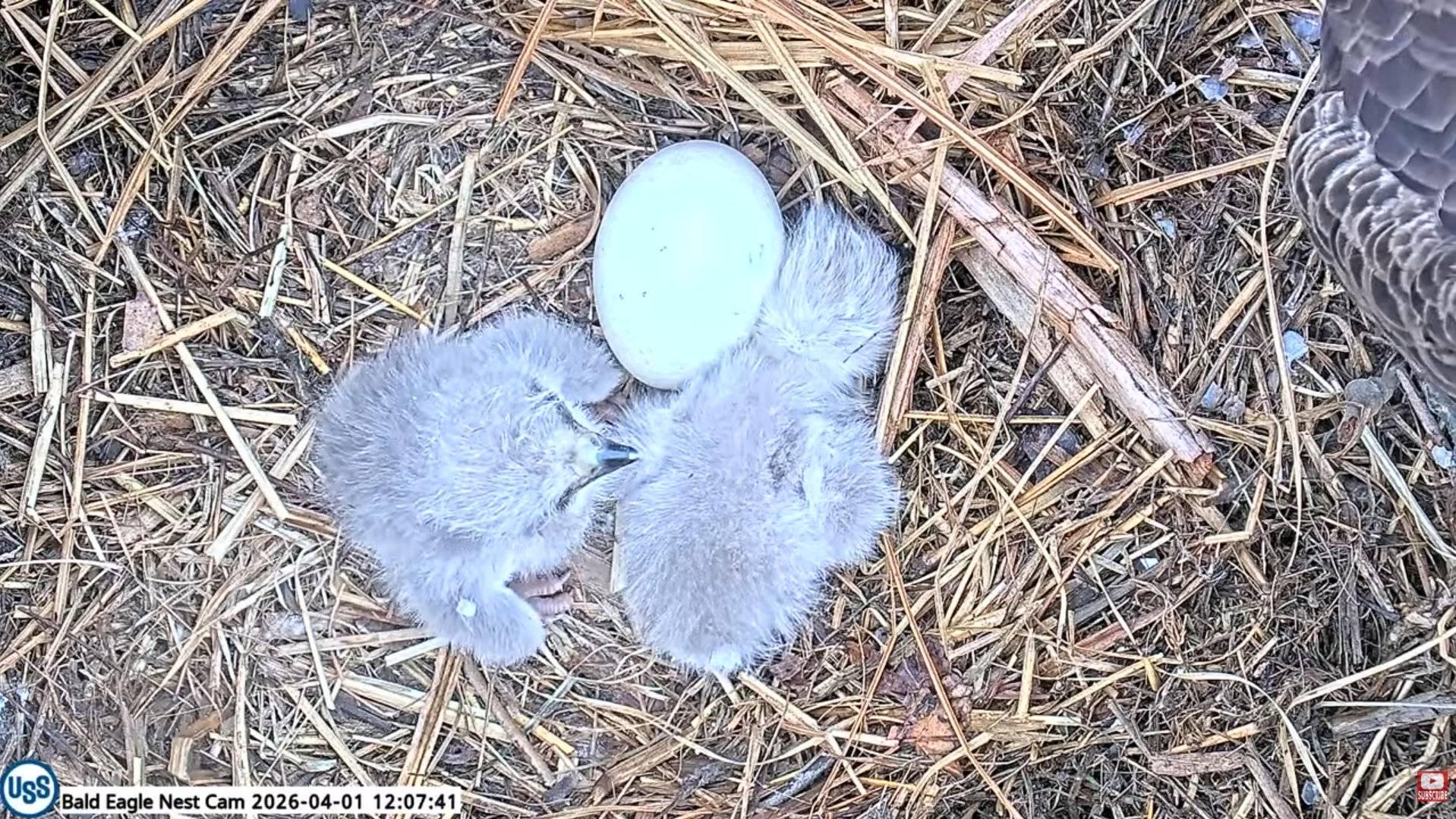
From the urban skyline and rivers of Pittsburgh to the protected wetlands of Iroquois National Wildlife Refuge and the winding waterways of Little Miami River, eaglets hatched at every nest we follow. At the Glen Hazel (Hays) Bald Eagle Nest, the United States Steel Corporation Bald Eagle Nest, the Iroquois National Wildlife Refuge Bald Eagle Nest, and the Little Miami Conservancy Bald Eagle Nest, each one now holds a new generation of bald eagles.
It’s a reminder of why we watch. Not just for the dramatic moments, but for the slow build, the weeks of incubation, the uncertainty, and then suddenly, life.
From Egg to Life: The Laying Stage
Long before this week’s excitement, the story began quietly, with the laying of eggs.
Bald eagles typically lay their eggs several days apart, often two to four days between each one. It’s a detail that may seem small, but it shapes everything that follows. From the moment the first egg appears, the rhythm of the nest changes. The adults shift into a careful routine of incubation, taking turns to keep the eggs warm and protected.
You’ll often see one eagle settled low in the nest, feathers fluffed, carefully adjusting their position. Beneath them, the eggs are kept at a precise temperature, gently rotated to ensure proper development. It’s patient, deliberate work, hours that stretch into days, and days into weeks.
For viewers, this stage can feel still. But it’s anything but inactive. Inside each egg, life is forming, slowly and steadily, preparing for the moment when everything changes.
The First Sign of Life: What is a “PIP”?
Then comes the moment that shifts anticipation into excitement, the first pip.
A “PIP” (Peep is Pecking) is the tiny crack or hole that appears in the eggshell when the chick begins to break through. It’s created using a small, temporary structure on the chick’s beak called an egg tooth. At first, it can be easy to miss, a small mark on a large egg, but once you see it, everything changes.
That single crack tells you the chick is alive, active, and beginning the demanding process of hatching. But it’s not quick. From the first pip to full emergence can take anywhere from a full day to three days. During that time, progress may seem slow or even stalled, but in reality, the chick is resting, gathering strength, and continuing its work from inside.
For those watching live, the pip is often the moment that draws everyone in. It’s the beginning of something you know is coming, you just don’t know exactly when.
Hatching Day: A Test of Strength
Hatching is not a single moment, it’s a process, and a demanding one at that.
Over the course of many hours, sometimes longer, the chick works its way around the inside of the egg, slowly breaking the shell in a circular pattern. This process, often called “zipping,” requires strength and persistence. Eventually, the shell gives way, and the eaglet emerges, wet, exhausted, and incredibly vulnerable.
At first, the chick can barely lift its head. Its movements are small, unsteady. But it doesn’t take long for instinct to take over. Within hours, you may see the eaglet begin to stretch upward, opening its beak to beg for food.
The parents respond almost immediately. One of the most remarkable transitions to witness is how quickly the focus shifts, from protecting the egg to feeding the chick. Tiny pieces of fish or prey are carefully offered, marking the eaglet’s first meals in the world outside the shell.
Why Eaglets Hatch Days Apart
One of the most noticeable things viewers observe is that not all eaglets hatch at the same time.
Because the eggs are laid days apart, they typically hatch that way as well. The first egg laid is usually the first to hatch, followed by the next one a couple of days later, and sometimes a third after that. This creates a natural size and strength difference between siblings right from the start.
At first glance, it might seem like an imbalance, but it’s actually part of the species’ survival strategy. In times when food is plentiful, multiple eaglets can thrive. When conditions are more challenging, the staggered hatching increases the chances that at least one chick will grow strong enough to survive.
Watching this dynamic unfold can be one of the more emotional parts of following a nest. It’s a real, unfiltered look at how nature works, sometimes harsh, but always purposeful.
What Happens Next: The Road to Fledging
With all four nests now home to hatchlings, the next chapter is just beginning, and it unfolds quickly.
In the early weeks, the eaglets will remain almost constantly under the watchful care of their parents. They’ll be brooded for warmth, fed frequently, and grow at a surprising pace. Before long, their movements become stronger, their heads steadier, and their personalities begin to show.
As the weeks pass, you’ll notice the development of feathers, the first signs of wing stretching, and eventually the unmistakable motion of flapping. The nest, once a place of stillness, becomes increasingly active. Siblings jostle, explore, and begin testing their strength.
By the time they reach several weeks old, the eaglets will start “branching”, moving beyond the center of the nest to nearby limbs. And then, almost suddenly, comes the moment everything has been building toward: their first flight.
Fledging typically occurs around 10 to 12 weeks after hatching. Even then, the story doesn’t end. Young eagles often return to the nest area, continuing to learn from their parents as they gain independence.
Keep Watching: The Best Is Still Ahead
If there’s one thing we’ve learned from following these eagles, it’s that the hatch is only the beginning.
In the weeks ahead, there will be countless moments worth watching, feedings, sibling interactions, first stretches of the wings, and eventually, those first flights. Some will happen quickly. Others will take patience. All of them will matter.
The beauty of watching wildlife this way is that you don’t just see the highlights, you experience the full story as it unfolds.
And right now, that story is just getting started.
Watch our bald eagle nest live streams here:
Glen Hazel (Hays) Eagles, Pittsburgh, PA
https://pixcams.com/hays-bald-eagle-nest/
United States Steel Corporation, Pittsburgh, PA
https://pixcams.com/u-s-steel-bald-eagle-nest-cam-quad-view/
Iroquois National Wildlife Refuge Bald Eagle Camera, western New York
https://pixcams.com/iroquois-national-wildlife-refuge-bald-eagle-camera/
Little Miami Conservancy, Miami Ohio
https://pixcams.com/lmc-bald-eagle-nest/

 ByBill