A Winter Surprise at the Feeder: Could an Evening Grosbeak Visit You?
WildWatch Weekly A Winter Surprise at the Feeder: Could an Evening Grosbeak Visit You? Live Cams Latest Posts Store Facebook YouTube The Unexpected Moment Winter feeder watching often settles into a familiar rhythm. The same regulars arrive at roughly the same times, following patterns you come to recognize without thinking about them. You glance out the window or check the camera feed expecting what you usually see, until suddenly, something feels different. Maybe it’s a flash of bold yellow...
Winter feeder watching often settles into a familiar rhythm. The same regulars arrive at roughly the same times, following patterns you come to recognize without thinking about them. You glance out the window or check the camera feed expecting what you usually see, until suddenly, something feels different.
Maybe it’s a flash of bold yellow where muted browns and grays usually dominate the scene. Or a bird with a heavier build and an oversized bill that doesn’t quite match the mental list of your usual visitors. For a moment, you’re not even sure what you’re looking at, only that it’s unfamiliar enough to make you stop and look closer. That pause, that second glance, is often how an Evening Grosbeak announces itself.
That’s part of the quiet magic of winter birding. Sometimes the season doesn’t bring something entirely new, it brings something unexpected. A bird you weren’t looking for, on a day that looked like every other winter day. And long after it’s gone, the surprise of that moment lingers, reminding you that even your most familiar feeder can still hold a few secrets.
Meet the Evening Grosbeak
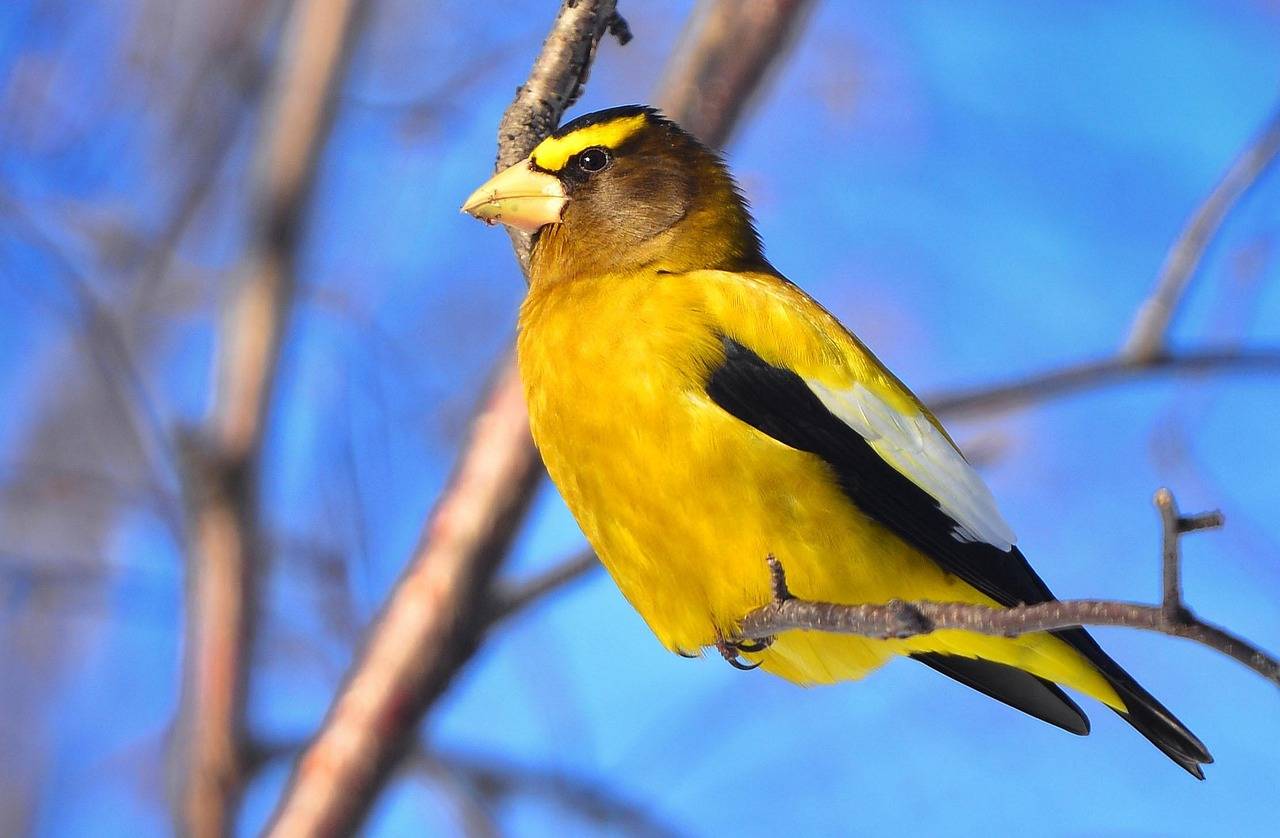
At first glance, the Evening Grosbeak doesn’t look delicate or subtle. It’s a solid, stocky bird with a thick, pale bill that seems almost oversized for its head, built more like a seed-cracking specialist than a dainty finch. That heavy bill is often the first clue that you’re looking at something different, even before color comes into focus.
Adult males are especially striking, with bold yellow bodies accented by deep black wings and a contrasting splash of white. Females and younger birds wear softer tones, grays, creams, and muted yellows, but still carry the same sturdy shape and unmistakable presence. Whether bright or subdued, they stand out against the muted palette of winter, especially when snow or bare branches frame the scene.
Evening Grosbeaks are also social birds. When they appear, they often arrive in small, noisy groups, announcing themselves with sharp calls and a confident, almost casual approach to the feeder. They’re not flashy in their movements and don’t perform for attention, but once you’ve seen one, there’s no mistaking it. In fact, many people realize something is different before they can name what it is. That moment of recognition is often when a backyard watcher meets an Evening Grosbeak for the very first time, even after years of feeder watching.
Where Do Evening Grosbeaks Come From?
For much of the year, Evening Grosbeaks live far from most backyards. They’re birds of northern forests and western mountain regions, spending their time in areas dominated by conifers and mixed woodlands where natural seed sources are plentiful. Because their core range lies well north and west of many populated areas, they can feel unfamiliar, even to people who’ve been watching feeders for decades.
What makes Evening Grosbeaks especially intriguing is the way they move in winter. Unlike many migratory birds that follow reliable, clockwork routes, their winter travel is irregular. Some years they wander far beyond their usual range, while in other years they may barely move at all. These movements depend heavily on food conditions, not calendars. When cone crops or other natural food sources fail farther north, flocks may drift south and east in what birders call an irruption, sudden, unpredictable, and unevenly distributed.
That unpredictability is why they can seem rare without actually being in trouble. An empty feeder one winter doesn’t mean Evening Grosbeaks have disappeared, it simply means conditions didn’t send them your way that year. And when they do appear, their visits are often brief. They may stay for a few days or weeks before moving on, leaving behind a vivid memory of bright color, heavy bills, and the unmistakable sense that you witnessed something special, if only for a moment.
When Might You See One?
If an Evening Grosbeak does visit your feeder, timing matters, but not in a predictable, calendar-marked way. These birds are most likely to appear mid-winter through early spring, often between December and March. Even then, the exact window depends on regional weather and food conditions far beyond your backyard. Two homes just miles apart can have completely different experiences in the same winter.
Part of what makes an Evening Grosbeak sighting so memorable is how suddenly it can happen. One day your feeder hosts its usual winter regulars; the next, a bold new bird appears without warning. And just as quickly as they arrive, they can disappear. Some Evening Grosbeaks linger for several days or even weeks, while others stop briefly, sometimes for only a single feeding, before moving on.
That unpredictability is where feeders and cameras shine. You can’t always be at the window when something unexpected happens, but a camera quietly watching in real time, or waiting to be replayed, often catches what our schedules miss. Reviewing footage can reveal brief visits, repeat patterns, or that one fleeting moment that turns an ordinary winter day into a lasting memory.
How to Attract Evening Grosbeaks to Your Feeder
Attracting an Evening Grosbeak is less about perfect technique and more about being ready when opportunity passes through. If they do arrive in your area, offering the right food can make your feeder worth a stop. Their powerful bills are well suited for black oil sunflower seeds and hulled sunflower kernels, both high-energy options that are easy for them to crack or consume quickly. Some Evening Grosbeaks will also take safflower, though sunflower tends to be the clear favorite.
Feeder style matters, too. Platform or tray feeders work especially well because they accommodate the Grosbeak’s stocky build and confident feeding style. These birds aren’t delicate, they lean in, jostle for space, and eat with enthusiasm, so a sturdy feeder is important. Lightweight hanging feeders may sway too much or feel awkward for them, while solid platforms provide a comfortable place to land and feed.
Placement can make a difference in how long they linger. Feeders set in quieter areas, away from heavy foot traffic or sudden movement, allow Evening Grosbeaks to feed more calmly. That said, it’s important to keep expectations realistic. You can do everything “right” and still never see one. Whether an Evening Grosbeak visits your feeder depends far more on regional winter movements than individual effort. Offering the right setup simply ensures that if one does pass through, you’re ready for the surprise.
Why Seeing One Matters
Spotting an Evening Grosbeak at your feeder isn’t important because it’s rare, it matters because it reminds us that winter is not a quiet pause in nature. Even when landscapes look frozen and familiar, birds are responding constantly to shifting conditions. Forest seed crops rise and fall, weather patterns change, and food availability nudges birds to move in ways we don’t always see. A sudden visit from an unexpected bird is often the first visible sign of those unseen changes.
An Evening Grosbeak doesn’t arrive with a message or a warning, it simply shows up, feeds, and moves on. But that brief appearance connects your backyard to boreal forests, mountain woodlands, and weather systems hundreds of miles away. The feeder outside your window becomes part of a much larger story, one shaped by ecosystems working in real time rather than by neat seasonal boundaries.
Moments like these don’t need big conclusions or urgent interpretations. They’re meaningful because they sharpen our awareness. They remind us that watching, patiently and without expectation, can reveal connections we might otherwise miss. Sometimes noticing a single, unexpected bird is enough to change how we see the season itself.
Watching for the Unexpected
One of the quiet lessons backyard birds teach us is that not everything arrives on schedule. Feeders develop routines, but nature doesn’t follow a script. The birds we remember most aren’t always the ones we expect, they’re the ones that appear without warning, linger just long enough to be noticed, and then move on. Those unplanned moments are often what turn casual watching into something deeper.
Patience is what makes those moments possible. When we slow down and keep watching, day after day, even when nothing seems new, routine begins to reveal subtle change. A different shape on the feeder. A flash of unfamiliar color. A visitor that doesn’t quite fit the pattern. That’s often how an Evening Grosbeak makes its entrance, not with drama, but with quiet surprise.
This is where PixCams comes in. Cameras extend our attention beyond the moments we happen to be looking out the window. Rewatching footage lets patterns emerge, short visits we missed, repeat behaviors, or a brief appearance that would have gone unnoticed in real time. By slowing us down, cameras help us see change as it unfolds, reminding us that discovery doesn’t always announce itself. Sometimes, it simply waits for us to notice.
Closing Invitation: Keep Looking
As winter settles in, the best thing you can do is keep watching. Pay attention to the details, the size of a bird that seems a little larger than the finches you’re used to, a heavier bill, or a splash of color that doesn’t quite match your mental checklist. Sometimes the first clue that something special has arrived isn’t recognition, but curiosity.
Unfamiliar birds often reveal themselves through behavior as much as appearance. A small group arriving together, a confident approach to the feeder, or a feeding style that feels different can all signal an unexpected visitor. Moments like these are easy to miss unless you slow down and look closely. That’s often how an Evening Grosbeak makes its mark, briefly, quietly, and memorably.
If you do notice something unusual, we’d love to hear about it. Share your sightings, photos, or clips, and help build the shared story of what’s moving through our backyards this winter. And think back for a moment: have you ever had a bird show up at your feeder that made you stop and say, “What is that?” Those are the moments that make watching worthwhile, and they’re always worth sharing.

 Byadmin