A Bird That Belongs to Winter
When winter tightens its grip, when fields fall silent, winds sweep across frozen ground, and snow blurs the line between earth and sky, most birds are already gone. Feeders grow quieter. Familiar flashes of color disappear south. And then, sometimes, a small white bird appears where you least expect it, lifting off the snow as if it were part of the storm itself.
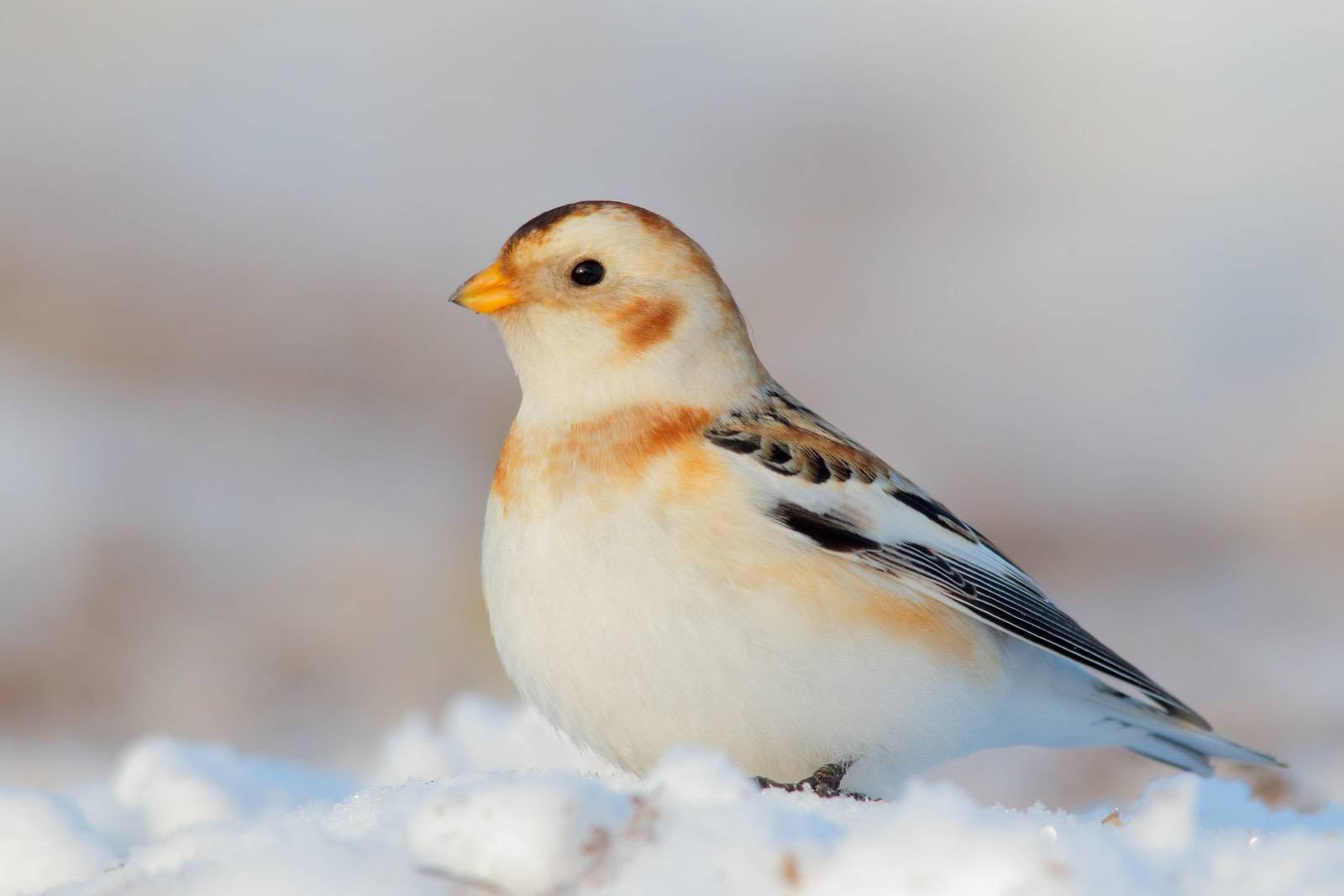
The Snow Bunting doesn’t simply endure winter. It belongs to it. While many birds retreat from cold and scarcity, Snow Buntings arrive just as winter settles in, moving across open fields and shorelines like living snowflakes. Their pale plumage blends so perfectly with the season that they can vanish in an instant, one moment present, the next swallowed by wind and white.
For many of us, the Snow Bunting is a winter-only visitor, a fleeting guest from the far north. Seeing one feels different than spotting a familiar backyard bird. It feels like a quiet privilege, an encounter meant for those willing to look closely when the landscape seems empty. In a season that often feels still and colorless, the Snow Bunting reminds us that winter has its own wildlife stories, waiting patiently in the cold.
Meet the Snow Bunting — Not a Finch, Not a Sparrow… Something Else
At first glance, the Snow Bunting can be hard to place. It’s not quite a finch, not really a sparrow, and it doesn’t behave like most songbirds people recognize. That’s because it’s something a little different altogether, an Arctic-breeding songbird built for extremes. Snow Buntings nest far north on open tundra, then travel long distances each year to spend winter in places where snow, wind, and bare ground dominate the landscape.
Unlike many birds that rely on feeders or trees, Snow Buntings are ground foragers. In winter, they search open fields, shorelines, and windswept areas for seeds poking through snow or frozen soil. They move in loose flocks, rising and settling together in rolling waves, always close to the ground. Their lifestyle fits winter perfectly, wide open spaces, few hiding places, and constant motion to stay warm and fed.
Part of what makes Snow Buntings so easy to overlook is how dramatically they change with the seasons. In summer, they wear darker, more patterned feathers that blend into rocky tundra. By winter, they transform, bright white bodies with crisp black accents that flash in flight. Against snow-covered fields, they can seem to disappear entirely, reappearing only when the flock lifts off in a sudden swirl.
Because of this, many people see Snow Buntings without ever realizing what they’re looking at. A flicker of white against the snow. A gust that seems to move on its own. They are, quite literally, the birds people mistake for snow itself, until they stop, watch closely, and realize winter is more alive than it first appears.
Built for the Cold — Why Snow Buntings Thrive When Others Leave
Winter is unforgiving, yet Snow Buntings meet it head-on. These birds are wrapped in exceptionally dense feathers that trap heat and shield them from biting wind, allowing them to remain active when temperatures plunge. Instead of retreating, they continue their daily routines, feeding, flying, and socializing, across landscapes most birds abandon. The cold doesn’t slow them down; it’s simply the environment they’re built for.
Food is scarce in winter, but Snow Buntings know where to look. They forage directly on frozen ground and windswept snowfields, searching for seeds exposed by drifting snow or uncovered by gusts of wind. Where trees and feeders offer little, open spaces become their pantry. Watching them work a field feels purposeful and efficient, as if every movement has been practiced for generations.
They rarely face winter alone. Snow Buntings travel and feed in flocks, a strategy that offers warmth, safety, and shared awareness. Many eyes spot danger sooner. Many bodies hold warmth better. Their synchronized movements, lifting together, settling together, are one of winter’s quiet spectacles, a reminder that survival often depends on cooperation.
In many ways, Snow Buntings resemble hardy winter hikers. They layer up, stick together, and understand the landscape well enough to know where food still exists when conditions are toughest. They don’t rush through winter, they move with it. And in doing so, they earn a special kind of respect: proof that winter isn’t just something to endure, but something that can be mastered.
Where You Might See One — Winter Visitors from the Arctic
Snow Buntings may come from the far Arctic, but you don’t need to travel anywhere remote to encounter one. In winter, they trade tundra for wide, open spaces closer to home, places that feel a little emptier this time of year. Think snow-covered farmland, frozen shorelines, coastal dunes, and windswept fields where trees are few and the ground is exposed. These open landscapes mirror the wide horizons they’re used to, even hundreds or thousands of miles south of their breeding grounds.
Unlike many winter birds that stick close to feeders or wooded edges, Snow Buntings prefer places most of us pass by without a second glance. A quiet farm field after a snowfall. A shoreline on a cold, gray morning. A stretch of ground where the wind has scoured the snow thin. These are the moments and places where a flash of white might suddenly lift from the ground, revealing that winter isn’t as empty as it seems.
What makes a Snow Bunting sighting special is the balance between rarity and accessibility. They aren’t common everywhere, and they don’t appear every winter, but when conditions are right, they can show up almost anywhere with open ground and snow. You don’t need special equipment or expert knowledge. You just need to be outside, paying attention, at the right time.
That’s why spotting a Snow Bunting often feels like a small winter reward. A quiet gift for those willing to look closely when the season feels still. In a landscape many people rush through on their way to spring, the Snow Bunting reminds us that winter has its own moments of wonder, brief, subtle, and deeply worth noticing.
Behavior to Watch For — Snowflakes That Move Together
One of the easiest ways to recognize Snow Buntings is not by a single bird, but by the way they move together. In flight, they skim low over open fields in a rolling, wave-like motion, rarely climbing high into the sky. Against a winter landscape, their white bodies flash and vanish, appearing almost like gusts of wind lifting snow from the ground.
When a flock takes off, it happens all at once. A quiet field suddenly erupts in motion, dozens of white shapes swirling upward before settling again just a short distance away. The effect is brief and mesmerizing, a living snowfall that rearranges itself in seconds. If you lose track of them, pause and look closely. They’re often right back on the ground, blending in once more.
Snow Buntings feed directly on snow-covered or frozen ground, walking and hopping as they search for seeds exposed by wind or movement. They don’t rush. Their foraging looks deliberate, almost methodical, as if they know exactly where winter still offers food. Watching them closely reveals a steady rhythm that’s easy to miss if you’re only glancing as you pass by.
The key to spotting Snow Buntings is slowing down. Watch where they land after a sudden lift-off, often just beyond where you expect. Listen carefully, too. Their calls are soft and musical, carrying gently over open spaces rather than cutting through the air. In a season defined by quiet, those subtle sounds and movements are what bring winter landscapes to life.
Why They Matter — Winter Birds Tell Important Stories
Snow Buntings may seem like fleeting winter visitors, here one moment, gone the next, but their presence carries meaning. These birds are closely tied to cold, open landscapes, and where they appear (or don’t) can tell us a great deal about the winters we’re experiencing. Shifts in snowfall, temperature, and available habitat all influence when and where Snow Buntings move. In that way, they quietly reflect changes happening across much larger scales.
What makes Snow Buntings especially powerful is that they deliver these messages without fanfare. They aren’t statistics or charts, they’re living indicators. A flock lifting off a frozen field can signal the right combination of snow cover, exposed food, and winter conditions. Fewer sightings over time can hint at landscapes changing in ways we might not notice day to day. Their story is written softly, in movement and absence, rather than headlines.
At PixCams, we believe those quiet stories matter. Winter birds like Snow Buntings remind us that meaningful observation doesn’t require travel, expertise, or perfect conditions. It starts locally, with a field, a shoreline, a backyard, or a livestream watched closely. Each moment of noticing adds to a bigger picture of how wildlife responds to the world around it.
As winter continues, we invite you to keep watching. Pay attention to the birds that stay, the ones that arrive when others leave, and the subtle signs they share. Even in the coldest season, there is life, movement, and meaning all around us, waiting for someone to notice.

 Byadmin