WildWatch Weekly Tiny but Mighty: Meet Pennsylvania’s Wrens Live Cams Latest Posts Store Facebook YouTube Carolina Wren Small Birds, Big Personalities If you’ve ever heard a burst of rapid, bubbling song pouring out of a hedge, woodpile, or marsh only to spot a tiny brown bird bouncing through the shadows, chances are you’ve just encountered a wren. Wrens are some of Pennsylvania’s most energetic, vocal, and surprisingly diverse songbirds, yet they often go unnoticed. Their modest colors help...
If you’ve ever heard a burst of rapid, bubbling song pouring out of a hedge, woodpile, or marsh only to spot a tiny brown bird bouncing through the shadows, chances are you’ve just encountered a wren.
Wrens are some of Pennsylvania’s most energetic, vocal, and surprisingly diverse songbirds, yet they often go unnoticed. Their modest colors help them blend into brush and grasses, but their voices tell a very different story. For such small birds, wrens sing loud, complex songs, defending territories, advertising nest sites, and staying in constant communication with their world.
What makes wrens especially fascinating is that Pennsylvania hosts wrens year-round, wrens that only appear in winter, and wrens that arrive just for the breeding season. Few bird families offer such a mix of residents and visitors making PA a fantastic place to get to know these tiny powerhouses.
A Wren for Every Season in Pennsylvania
Unlike many birds that fit neatly into “summer” or “winter” categories, wrens blur those lines.
Some wrens stay with us all year, braving cold snaps and snow.
Others slip into Pennsylvania quietly in winter, favoring dense forests and ravines.
And a few arrive in spring and summer only, filling wetlands and backyards with song before vanishing again by fall.
This seasonal shuffle means wrens are present in nearly every habitat from suburban yards and brush piles to deep woods and cattail marshes, if you know where (and when) to look.
Carolina Wren
Year-Round Neighbors: The Carolina Wren
The Carolina Wren is Pennsylvania’s most familiar year-round wren, and without question, one of its boldest. While many small songbirds retreat south once winter sets in, Carolina Wrens stay put, facing snow, ice, and freezing nights with remarkable resilience. Their presence is often announced long before they’re seen, making them one of the few birds whose voice feels just as permanent as the seasons themselves.
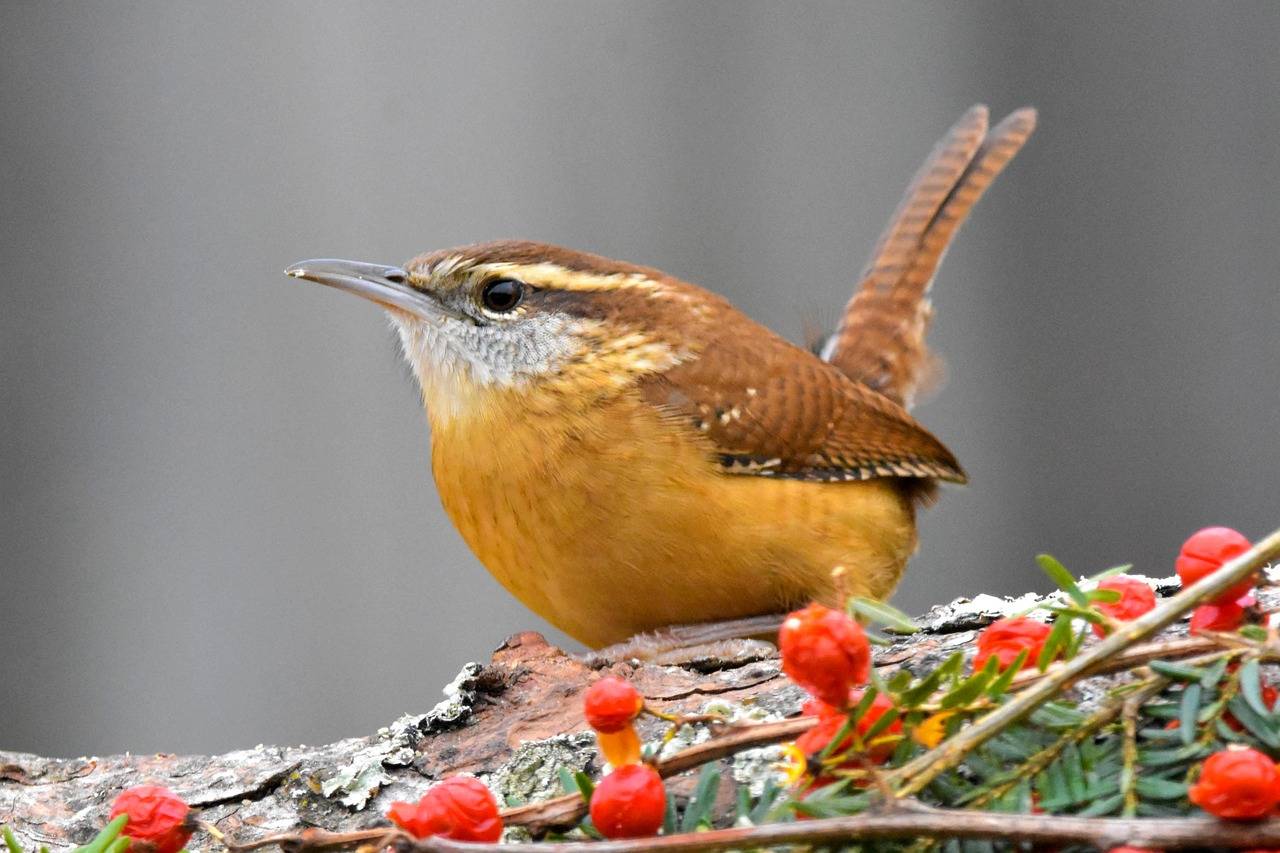
Stocky and compact with rich, warm brown plumage and a bold white eyebrow stripe, Carolina Wrens are often spotted traveling in pairs. These lifelong partners maintain close bonds throughout the year, constantly calling back and forth as they explore their territory together. Their famous teakettle-teakettle-teakettle song can ring out even on the coldest winter mornings a sound so loud and confident it seems impossible for such a small bird to produce.
Unlike many backyard birds, Carolina Wrens don’t rely heavily on seed feeders. Instead, they thrive in tangles and shelter, hunting insects and spiders in brush piles, woodpiles, fallen logs, thick ivy, and the forgotten corners of porches and sheds. They’re masters at squeezing into tight spaces, often disappearing into places other birds never explore under deck stairs, inside stacked firewood, or deep within evergreen shrubs.
In recent decades, Carolina Wrens have steadily expanded northward, and today they’re a regular sight (and sound) across much of Pennsylvania. Their success is closely tied to human landscapes, where buildings, nest boxes, and sheltered nooks provide critical protection from harsh winter weather. Cold snaps can still take a toll, but mild winters and backyard habitat have allowed these wrens to thrive far beyond their historic range.
For many Pennsylvanians, the Carolina Wren has become a year-round companion, a small, fearless presence that reminds us life doesn’t go quiet just because winter arrives. When snow covers the ground and most birds fall silent, the Carolina Wren keeps singing, proving that some of the toughest wildlife neighbors come in very small packages.
Backyard Builders: The House Wren
If you’ve ever put up a nest box in spring, chances are you’ve crossed paths with the House Wren Pennsylvania’s most common and energetic breeding wren. These tiny, cinnamon-brown birds return each year in late April or May, often arriving almost overnight. One day your yard is quiet, and the next it’s alive with sharp chatter and bubbling song as House Wrens reclaim their summer territories.
House Wrens are famous for their intense nesting habits. Males eagerly stuff nest cavities with sticks, sometimes filling several boxes or holes with what biologists call “dummy nests.” This behavior helps attract a mate and may also block competitors from using nearby sites. Once a female chooses a spot, she lines the chosen nest with softer materials and gets to work raising a brood often more than one in a single season.
They thrive in human-altered landscapes: backyards, parks, gardens, and woodland edges where shrubs, fences, and brush provide both food and shelter. Their rapid, cheerful songs, a tumbling series of trills and chatter, become one of the most familiar sounds of early summer mornings. Despite their tiny size, House Wrens are bold defenders of their space, fearlessly chasing off birds much larger than themselves.
But their presence is fleeting. By late summer and early fall, House Wrens begin their journey south to warmer regions of the southern U.S., Mexico, and Central America. Nest boxes that were once bursting with activity suddenly sit empty, and the nonstop chatter fades away. Their departure is a gentle reminder that many of our most familiar backyard voices are only seasonal guests — and that spring will one day bring them back again.
Winter Visitors: The Elusive Winter Wren
Despite its name, the Winter Wren doesn’t usually nest in Pennsylvania but it does slip into the state during migration and often spends the colder months here, tucked away in the quietest corners of our forests. For many birders, spotting one feels more like discovering a secret than finding a bird. They’re present, but rarely obvious, favoring places where shadows, moss, and fallen timber create a world of cover.
One of the smallest wrens in North America, the Winter Wren looks almost round, with dark brown plumage and a famously short, cocked tail. It thrives among tangled roots, rotting logs, stream banks, and rocky ravines, where it hops mouse-like through leaf litter in search of insects and spiders. More often than not, you’ll notice a sudden flick of movement, a blur disappearing into the undergrowth before you ever get a clear look.
Unlike the bold Carolina Wren, Winter Wrens are usually silent through much of winter, making them even harder to detect. But during early spring migration, lucky listeners may hear one of the most extraordinary songs in the forest: a long, cascading series of trills and notes that spill out with incredible speed and power. It’s a song that seems far too big for such a tiny bird, echoing through still woods like a hidden fountain of sound.
For those who catch a glimpse or hear that fleeting melody, the Winter Wren becomes unforgettable a reminder that some of Pennsylvania’s most remarkable wildlife moments belong to those who linger in quiet places and listen closely.
Wetland Specialists: Marsh Wren & Sedge Wren
Pennsylvania’s wetlands host two of the state’s most specialized and least-seen wrens birds that trade backyards and woodpiles for cattails, sedges, and open marsh. To find them, you often have to leave the trails behind and listen across waving grasses, where sound carries farther than sight and birds live largely hidden from view.
Marsh Wrens arrive in spring and summer, turning cattail marshes and reedy ponds into buzzing soundscapes. Small and boldly patterned with black, white, and rich brown, they cling to swaying stalks and stitch together distinctive globe-shaped nests anchored to reeds above the water. Males may build several nests in a season, using them to attract mates and mark territory. Their sharp, mechanical songs a rapid series of clicks and trills ripple across wetlands as they fiercely defend their tiny patches of reeds from rivals.
Even more elusive is the Sedge Wren, one of Pennsylvania’s rarest songbirds and a state-endangered species. Smaller and paler than the Marsh Wren, sedge wrens favor grassy wetlands, wet meadows, and hayfields rather than cattails. They are famously nomadic, appearing in one location for a year or two, then vanishing without warning. Some seasons they may not be found at all. Their soft, chattering songs are easy to miss, and their secretive habits make every sighting feel like a small discovery.
Seeing or hearing either of these wrens is a powerful reminder of how vital healthy wetlands are not just for water and flood control, but for wildlife that depends entirely on these fragile habitats. In places where most of us see only reeds and grasses, wrens are living out complex, hidden lives. They show us that some of Pennsylvania’s richest bird stories unfold where few people think to look.
Why Wrens Are So Easy to Miss — and So Worth Noticing
Wrens don’t rely on bright colors or graceful flights to catch our eye. In a world of flashing cardinals and soaring hawks, they blend quietly into browns and shadows. What sets them apart instead is pure energy a constant flurry of motion and sound. They creep along logs, bounce through brush, scold intruders with sharp chatter, and burst into song with voices far bigger than their bodies. Wrens live life at ground level, always moving, always searching, always announcing that something lively is happening just out of sight.
Their secret lies in where they choose to live. Wrens thrive in the messy edges of our landscapes, brush piles, tangled vines, woodpiles, fallen trees, thick hedgerows, and dense cattails. These are places many of us overlook or even clean up, yet they’re exactly what wrens need for shelter, nesting, and hunting insects. By slipping into cracks and shadows other birds avoid, wrens turn clutter into opportunity.
That’s why wrens are so easy to miss. They don’t pose in open branches or gather at feeders. But for those who slow down and listen, wrens become impossible to forget. They reward patience with moments of surprise a sudden song from a thicket, a flash of movement at your feet, a tiny bird emerging from what looked like nothing at all. In noticing wrens, we’re reminded that some of nature’s richest stories unfold not in the spotlight, but in the quiet, tangled places right in front of us.
Watch & Learn: Spotting Wrens on PixCams
Wrens may be small and quick, but their busy lives make them some of the most rewarding birds to watch on PixCams and in the backyard. They’re frequent visitors to nest boxes, feeder areas, brush piles, and sheltered corners, often appearing suddenly and vanishing just as fast. Because they’re so active and curious, wrens offer endless opportunities to observe natural behaviors up close from bold inspections of new cavities to intense bursts of song delivered inches from the camera.
In spring, keep an eye out for rapid nest-building, as House Wrens in particular shuttle stick after stick into boxes, sometimes filling several before choosing one. Even in winter, you might spot Carolina Wrens peeking into crevices and cavities, searching for roosting spots or future nest sites. Their movements are often subtle but distinctive quick darting hops, a nervous bounce, and that telltale tail flick as they probe every crack for insects.
And then there’s the sound. Whether you’re watching live or listening nearby, notice how their songs seem far too loud for such tiny birds — sharp chatter, rolling trills, or the familiar teakettle call cutting through the air. These voices are your clue that wrens are nearby, even when they stay hidden in shadows.
By tuning into PixCams and paying attention to these small details, you begin to see just how much life unfolds in the background of our yards and woods. Sometimes the most fascinating wildlife moments don’t come from big animals or dramatic scenes, but from the smallest voices, telling their stories one quick flutter at a time.

 Byadmin