A Small Owl with a Big Presence
If you’ve ever stepped outside at dusk and heard a soft, wavering trill echo through the trees, you may have unknowingly crossed paths with one of Pennsylvania’s most remarkable nocturnal residents, the Eastern Screech Owl.
Despite their name, these owls don’t “screech” in the way most people imagine. Their calls are more like a gentle whinny or a series of soft trills, sounds that feel more like part of the night itself than something separate from it. It’s one of the many reasons they go unnoticed, even when they’re living just yards from our homes.
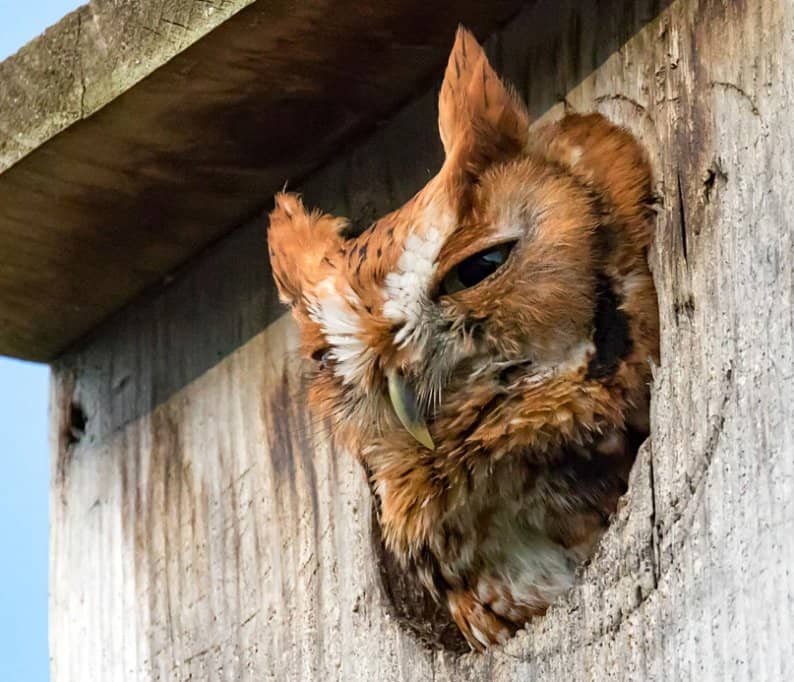
Standing only about 6–10 inches tall, screech owls are compact predators, but what they lack in size they make up for in adaptability and efficiency. Their feather patterns, whether gray or reddish, perfectly mimic tree bark, allowing them to disappear into plain sight. During the day, they often sit motionless in cavities, relying entirely on camouflage rather than movement for protection.
It’s this hidden nature that makes finally seeing one, especially through a nest cam, feel like uncovering a secret that’s been there all along.
Built for the Night: Silent Hunters in the Woods
The Eastern Screech Owl is a perfectly engineered nighttime hunter. Every part of its body is designed for stealth and precision.
Their wings are specially adapted with soft, fringed feathers that break up airflow, allowing them to fly almost completely silently. Prey rarely hears them coming. Combined with exceptional low-light vision and highly sensitive hearing, these owls can locate movement in near-total darkness, often by sound alone.
Their diet is surprisingly diverse. While small mammals like mice and voles are staples, they’ll also hunt insects, frogs, small birds, and even the occasional fish. This flexibility is one of the reasons they thrive in so many environments, including suburban neighborhoods.
Watching a screech owl hunt on camera reveals something striking, it’s not frantic or aggressive. It’s calm, calculated, and incredibly efficient. A short glide, a quick strike, and then stillness again.
Where They Live: Owls Among Us
One of the most fascinating things about Eastern Screech Owls is just how close they live to us.
They don’t require vast wilderness. Instead, they thrive in edge habitats, areas where woods meet open space. Backyards with mature trees, parks, orchards, and lightly wooded neighborhoods can all support these owls, as long as there are cavities available for shelter.
Because they don’t build their own nests, screech owls depend on existing holes, often abandoned woodpecker cavities or natural tree hollows. But in many areas, those natural options are limited.
This is where nest boxes become incredibly important.
At PixCams, your work placing and monitoring nest boxes has created reliable habitat where it might not otherwise exist. Over time, these boxes become part of the landscape, safe, familiar spaces that owls return to season after season.
And what starts as a simple box often becomes the center of an entire life cycle.
From Winter Roost to Spring Nest
Long before eggs are laid, the story begins in winter.
It’s not uncommon to see a single screech owl tucked into a nest box on a cold day, using it as a sheltered roost. These quiet winter visits are easy to overlook, but they’re often the first sign of something more to come.
As late winter approaches, behavior begins to shift.
Calls become more frequent. Pairs begin to form or reconnect. You may see two owls near a box, sometimes briefly sharing the space, sometimes taking turns. There’s a subtle but noticeable change from “just passing through” to “this might be home.”
By late February into March, that decision is made.
Once a female chooses a cavity, she commits to it—and the box transforms from a resting place into a nesting site.
Nesting Season: Life Inside the Box
The nesting season of the Eastern Screech Owl is a study in simplicity and dedication.
There are no elaborate nests, no woven grasses or carefully arranged materials. Eggs are laid directly on the floor of the cavity, sometimes with only minimal debris like fur or feathers beneath them.
A typical clutch ranges from 3 to 5 eggs, though larger clutches do occur. Once laying begins, the female takes on the role of full-time incubator, rarely leaving the nest. For roughly a month, she remains almost constantly with the eggs, relying entirely on the male to bring food.
And this is where one of the most fascinating dynamics unfolds.
Night after night, the male delivers prey, sometimes multiple times per hour, quietly arriving at the entrance and passing food to the female. On camera, these moments feel almost routine, but they represent an intense, continuous effort to sustain both mate and future offspring.
It’s a partnership built on timing, trust, and consistency.

A Proven Home: The Success of PixCams Nest Boxes
Over the years, one thing has become clear, when you provide the right space, Eastern Screech Owls will use it.
Since 2018, PixCams nest boxes have hosted at least 9 active nesting seasons across multiple boxes, with owls returning year after year to the same locations. What began as a simple effort to provide habitat has grown into a consistent, measurable success story.
In that time, PixCams boxes have produced 24 successfully fledged owlets, with several standout seasons. In both 2020 and 2021, four healthy owlets fledged from a single nest each year, an incredible level of success for a cavity-nesting owl. More recently, 2024 saw two active nests in the same season, producing six fledged owlets across two boxes, showing just how effective a network of boxes can be when properly placed and maintained.
Of course, not every season goes perfectly, and that’s part of the story too. There have been nests that failed to hatch, years impacted by predation, and even an abandoned nest in 2025. These moments are a reminder that even with the best conditions, wildlife is never predictable.
But taken together, the pattern is undeniable.
These boxes are not just being visited, they’re being trusted. Used for winter roosting, selected for nesting, and returned to across generations. What PixCams has created isn’t just a place to watch owls, it’s a place where owls are successfully raising their young.
And that’s what makes every new season worth watching.
Watch Our Screech Owls LIVE Here
https://pixcams.com/screech-owls/

Nesting Season: Life Inside the Box
The nesting season of the Eastern Screech Owl is a study in simplicity and dedication.
There are no elaborate nests, no woven grasses or carefully arranged materials. Eggs are laid directly on the floor of the cavity, sometimes with only minimal debris like fur or feathers beneath them.
A typical clutch ranges from 3 to 5 eggs, though larger clutches do occur. Once laying begins, the female takes on the role of full-time incubator, rarely leaving the nest. For roughly a month, she remains almost constantly with the eggs, relying entirely on the male to bring food.
And this is where one of the most fascinating dynamics unfolds.
Night after night, the male delivers prey, sometimes multiple times per hour, quietly arriving at the entrance and passing food to the female. On camera, these moments feel almost routine, but they represent an intense, continuous effort to sustain both mate and future offspring.
It’s a partnership built on timing, trust, and consistency.

Growing Up Owl: Rapid Change in a Small Space
When the eggs finally hatch, the pace of life accelerates almost immediately.
Tiny, down-covered owlets emerge blind and completely dependent. The female stays close, brooding them for warmth and protection, while the male increases his hunting efforts to meet the growing demand.
Within days, subtle changes begin.
Eyes open. Heads lift. Movement increases.
Within a couple of weeks, the nest box becomes a crowded, active space filled with curious, growing owlets. Their personalities begin to show, some bold, some cautious, all competing for position and food.
For viewers, this is often the most captivating stage.
Every feeding, every stretch, every interaction reveals something new. And because it all happens in such a confined space, you can witness development in a way that’s nearly impossible in the wild.
By around 4 to 5 weeks, the moment arrives.

One by one, the young owls climb to the entrance and take their first leap, fledging into the outside world, not yet strong fliers but ready to begin learning.
After the Box: Life Beyond the Nest
Fledging isn’t the end of the story, it’s just the beginning of a new phase.
Young screech owls don’t immediately disperse. Instead, they remain nearby, often hidden in dense foliage or perched quietly on branches during the day. At night, they continue to rely on their parents for food while slowly developing hunting skills of their own.
This period is full of trial and error.
Short flights become longer ones. Awkward landings become more controlled. Instinct begins to turn into experience.
Family groups may stay loosely connected for several weeks, with adults still responding to the calls of their young. Eventually, though, the juveniles disperse, each finding their own territory, and the cycle begins again.

A Season Worth Watching
Spring nesting season is one of the most dynamic and rewarding times to follow the Eastern Screech Owl.
It’s a season of quiet beginnings, one owl in a box on a cold day, that builds into a full, unfolding story of life, growth, and survival.
And it’s happening right now.
So whether you’re watching a PixCams live stream or simply listening at dusk, this is the moment to pay attention. Look for that small, watchful face at the entrance of a box. Listen for the soft trill drifting through the trees.
Because once you notice it, everything changes.
You’re no longer just outside at night.
You’re part of the story.
Watch Our Screech Owls LIVE Here – We hope to have eggs soon!!
https://pixcams.com/screech-owls/

 Byadmin