Lights Out for Migration: Helping Songbirds Find Their Way in the Dark
WildWatch Weekly Lights Out for Migration: Helping Songbirds Find Their Way in the Dark Live Cams Latest Posts Store Facebook YouTube While We Sleep, the Sky Comes Alive Most of us experience birds as part of the daytime world, bright flashes of color at the feeder, familiar songs drifting from the treetops, or the steady glide of wings across a blue sky. But as evening settles in and the last calls fade, something remarkable begins to take shape above us. The night sky, which feels still and...
Most of us experience birds as part of the daytime world, bright flashes of color at the feeder, familiar songs drifting from the treetops, or the steady glide of wings across a blue sky. But as evening settles in and the last calls fade, something remarkable begins to take shape above us. The night sky, which feels still and quiet from the ground, becomes a highway for migration.
Across North America, millions of songbirds lift off under the cover of darkness each spring. Warblers, thrushes, tanagers, and sparrows, birds we often think of as small and delicate, transform into endurance travelers, moving with purpose through the night. While we turn off the lights in our homes and settle in for sleep, they are just beginning their journey, climbing into the sky and setting a course that may span hundreds or even thousands of miles.
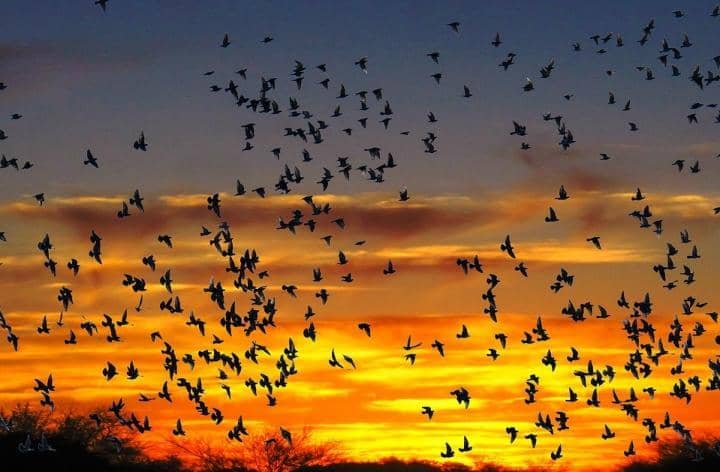
What makes this movement so extraordinary is how completely it goes unnoticed. There are no large flocks to watch, no dramatic formations crossing the horizon. Instead, these birds travel high above us, scattered across the sky, each following ancient instincts that guide them north. On peak migration nights, the air above our neighborhoods can be filled with life, thousands of birds passing overhead in just a few hours, et from the ground, the sky appears calm and empty.
It’s a powerful reminder that some of the most incredible events in nature aren’t always visible. They unfold quietly, persistently, and just out of sight. And once you realize what’s happening above you each night in spring, it changes the way you see the darkness, not as an absence of activity, but as a world alive with movement.
Why Migrate at Night?
For small songbirds, migrating at night isn’t just a behavioral quirk, it’s a finely tuned survival strategy. These birds are built for efficiency, and every ounce of energy matters on a journey that can span thousands of miles. By traveling after sunset, they avoid the heat of the day and the unstable air currents that come with it. Cooler temperatures and calmer winds allow them to fly longer distances with less effort, conserving the energy they’ll need to rest, refuel, and continue on.
Night also offers a layer of protection. Daytime skies are filled with predators, hawks, falcons, and other raptors that rely on sight to hunt. Under the cover of darkness, those threats are greatly reduced. For a small bird crossing unfamiliar landscapes, fewer predators can make the difference between completing the journey and never arriving.
But perhaps the most fascinating advantage of nighttime migration is the guidance system birds rely on. The night sky itself becomes a map. Many species are able to orient using the stars, learning their positions and patterns as a reference for direction. The moon can provide additional cues, and even when clouds obscure the sky, birds can tap into the Earth’s magnetic field to stay on course. It’s an extraordinary combination of instinct and adaptation, one that has been refined over thousands of years.
This delicate system depends on something we often take for granted: darkness. When the night sky is clear and natural, it provides the signals birds need to navigate safely. When it’s disrupted, the consequences can ripple across an entire migration.
How Songbirds Make the Journey
Unlike the familiar V-shaped formations of geese or the soaring kettles of hawks, most songbird migration happens quietly and without spectacle. These birds don’t travel in tight, visible flocks. Instead, they move alone or in loosely spaced groups, spread across vast stretches of sky. On any given night, thousands of individuals may be passing overhead, each following its own path, yet all part of the same seasonal movement north.
The journey begins shortly after sunset. As daylight fades, songbirds lift off from their resting areas and climb into the night sky, sometimes reaching altitudes of several thousand feet. Once at cruising height, they settle into a steady, purposeful flight, using favorable winds to help carry them along. Through the night, they maintain this rhythm, wingbeats steady, direction set, covering remarkable distances before the first light of dawn begins to appear.
As morning approaches, the skyward movement slows. Birds descend from their nighttime highway and drop into landscapes that can offer safety and food, woodlots, wetlands, fields, and even suburban backyards. These stopover sites are critical. Here, birds rest and refuel, often for just a day or two, before continuing their journey the next night. It’s a repeating cycle of fly, rest, and refuel that gradually carries them from their wintering grounds to their breeding territories.
In North America, spring migration builds from March through May, with April and early May often bringing peak movement in places like Pennsylvania. But migration isn’t constant, it pulses with the weather. Warm southern winds, rising temperatures, and clear skies can set the stage for what birders call “big migration nights,” when the conditions align and the sky fills with travelers. On those nights, an unseen wave of life moves overhead, compressing what might seem like a quiet evening into one of the busiest moments of the season.
The Hidden Danger: Artificial Light at Night
But as remarkable as this migration is, it’s increasingly challenged by something entirely new to the natural world, artificial light at night. For countless generations, songbirds have relied on the steady, predictable cues of the night sky to guide their journeys. Today, that sky is often washed out by the glow of cities, buildings, and neighborhoods that never truly go dark.
Bright lights can confuse and disorient migrating birds, pulling them off course. Instead of following the stars, they are drawn toward illuminated areas where they may circle endlessly, unable to reorient themselves. This not only drains the energy they depend on to complete their journey, but also increases the risk of deadly collisions with buildings and windows, especially in urban environments where reflective glass and bright lighting create dangerous illusions of open sky.
The scale of this impact is staggering. Each year, millions of birds are lost during migration due to light pollution and collisions. It’s one of the leading human-related threats to migratory songbirds, and unlike many environmental challenges, it happens quietly, often unnoticed, in the same hours when migration itself is taking place.
Yet there is hope in how simple the solution can be. Reducing or turning off unnecessary outdoor lighting—particularly during peak migration periods—can dramatically lower the risk for these birds. By restoring even a small piece of natural darkness, we give migrating songbirds a clearer path forward, helping them stay on course and continue one of nature’s most extraordinary journeys.
Seeing the Invisible: The PixCams Migration Station
At PixCams, we’ve taken something that most people will never see, and made it impossible to ignore. Night migration has always been one of nature’s hidden stories, unfolding high above us while we sleep. But with our migration monitoring station, that invisible movement suddenly becomes visible in real time. See our Migration Station here: https://pixcams.com/bird-migration-live/
Using a thermal imaging camera, we’re able to detect birds flying overhead even in complete darkness. What looks like an empty night sky is instantly transformed. Small, glowing streaks and flickering dots appear across the screen, each one a bird on the move. Some pass quickly, others drift steadily through the frame, but together they reveal a constant flow of migration happening right above us. It’s not just a moment, it’s a stream of life moving through the night.
What makes this even more powerful is accessibility. To our knowledge, this is one of the only publicly available systems of its kind in North America, allowing anyone to witness nocturnal migration as it happens. You don’t need specialized equipment or years of experience, just a willingness to look a little closer. In doing so, the idea of migration shifts from something distant and seasonal to something immediate and deeply connected to the place you live.
And once you’ve watched a truly active migration night, it stays with you. Seeing dozens, sometimes hundreds, of birds passing overhead in just minutes changes your perspective. The night no longer feels empty. It feels alive, full of motion and purpose. It’s a reminder that even in the quietest hours, nature is still moving all around us, we just needed the right way to see it.
What You Can Do: Lights Out
Protecting migrating songbirds doesn’t require special equipment, training, or a big commitment. In fact, one of the most meaningful ways to help begins with something incredibly simple: awareness. Once you understand that thousands of birds may be passing overhead on any given spring night, it becomes clear that even small choices at home can have a real impact.
Artificial light is one of the biggest challenges these birds face during migration, but it’s also one of the easiest problems for us to address. During peak migration season, taking a few simple steps, like turning off unnecessary outdoor lights, closing blinds or curtains at night, and reducing decorative lighting, can make your home a safer part of the landscape. These actions help cut down on the glow that can disorient birds and pull them off course.
What’s powerful is how quickly these changes add up. When entire neighborhoods dim their lights, even slightly, it helps restore the natural darkness that migrating birds rely on to navigate. It creates safer passageways through areas that might otherwise be confusing or dangerous.
In the end, it’s a reminder that conservation doesn’t always have to be complicated. Sometimes, it’s as simple as flipping a switch, choosing darkness for a few hours so that millions of birds can continue their journey safely through the night.
A Different Way to See the Night
The next time you step outside after sunset, take a moment to slow down. Let your eyes adjust to the dark, let the noise of the day fall away, and simply stand still. Then, look up.
At first, the sky may seem quiet, empty even. But knowing what’s happening beyond what we can easily see changes everything. Somewhere above, far beyond the reach of porch lights and rooftops, birds are moving with purpose. Thousands of them. Each one following an ancient path, guided by instinct, reading the stars, and trusting the darkness to lead them safely north.
It’s a different way to experience the night. Not as a pause in the natural world, but as one of its most active and important chapters. The stillness we feel on the ground is only part of the story. Overhead, there is motion, energy, and a quiet determination playing out mile after mile.
And the most powerful part is this: we’re not just observers. With something as simple as turning off a light, we become part of that story. A small action here on the ground can help keep the sky clear for those travelers above, helping ensure that their journey continues, just as it has for generations.

 ByBill