Winter Guests Are Arriving: Meet Your Backyard’s Seasonal Birds
WildWatch Weekly Winter Guests Are Arriving: Meet Your Backyard’s Seasonal Birds Live Cams Donate Store Facebook YouTube Your Backyard Has a Winter Guest List That little gray bird hopping beneath your feeder? It may have spent the summer far to the north. The sparrow rustling through your leaves? It could be a seasonal visitor you have been overlooking for years. As Pennsylvania’s summer birds head south, another cast of characters moves in. For birds coming from northern forests and tundra,...
That little gray bird hopping beneath your feeder? It may have spent the summer far to the north. The sparrow rustling through your leaves? It could be a seasonal visitor you have been overlooking for years.
As Pennsylvania’s summer birds head south, another cast of characters moves in. For birds coming from northern forests and tundra, our state offers winter feeding grounds. Migration does not always mean a trip to the tropics, sometimes Pennsylvania is far enough!
The arrivals unfold throughout fall, rather than on one calendar date. Some visitors become familiar daily companions; others make only a brief appearance. Here are five birds worth watching for as your backyard’s winter guest list takes shape.
Dark-eyed Junco: The Snowbird Returns
For many backyard birdwatchers, the first Dark-eyed Junco (Junco hyemalis) is as much a seasonal milestone as the first colorful maple leaf. Nicknamed the “snowbird,” this small sparrow becomes a familiar sight as colder weather approaches.
Pennsylvania’s usual slate-colored juncos wear gray or gray-brown upperparts, pale bellies, and pinkish bills. Watch one take flight and you will see its best identification trick: white outer tail feathers that flash as it darts toward cover.
Many winter juncos arrive from northern breeding grounds, although some juncos also breed in the Appalachians. Look beneath feeders and around shrubs, where flocks hop about searching for seeds. Millet is a favorite. Once you spot that first flash of white, you may start noticing snowbirds everywhere.
American Tree Sparrow: A Northern Traveler with a Rusty Cap
The American Tree Sparrow (Spizelloides arborea, formerly Spizella arborea) brings a little of the far north to our winter landscape. These birds breed near the northern treeline and spend winter across southern Canada and the northern United States.
Look for a rusty cap, a rusty line behind the eye, and a small dark spot on an otherwise plain breast. Another helpful clue is the two-toned bill: dark above and yellow below. Those details can turn “another little brown bird” into a satisfying identification.
Despite its name, this sparrow spends plenty of time on the ground. Watch weedy fields, grassy edges, and seed-rich patches as late fall gives way to winter. A yard bordering open habitat may have a better chance of attracting one than a closely clipped lawn. Leave a few seed heads standing—you could be setting the table for a northern guest.
White-throated Sparrow: A Little Bird with a Big Voice
A rustle beneath the shrubs may be your first clue that a White-throated Sparrow (Zonotrichia albicollis) has arrived. These birds breed mainly in Canada and become familiar winter visitors in Pennsylvania’s brushy yards and woodland edges.
Their white throat patch is a useful starting point for identification. Look for striped heads and small yellow patches between the eyes and bill. Some have bold black-and-white head stripes, while others wear softer tan stripes; both are White-throated Sparrows.
Their whistled song is often remembered as “Oh, sweet Canada,” and you may hear it even in winter. They also visit feeders for millet and sunflower seeds, especially with nearby shelter. A brush pile gives them a place to retreat between meals. Spend a quiet moment watching the edges of your yard: the bird hiding there may have both a handsome face and a lovely voice.
Fox Sparrow: The Rusty Visitor Worth a Second Look
If a sparrow looks unusually large, richly rusty, and boldly spotted, pause before calling it a Song Sparrow. You may have found a Fox Sparrow (Passerella iliaca).
The reddish birds seen in eastern North America have rusty tails and heavy breast markings. Their feeding behavior is just as memorable: they hop and scratch backward with both feet, tossing leaf litter aside in search of food. Imagine a tiny bird enthusiastically digging through the backyard pantry.
In Pennsylvania, Fox Sparrows are especially worth watching for during fall and spring migration. Some remain through winter, particularly in milder areas such as southeastern Pennsylvania, but they are less dependable winter guests than juncos or White-throated Sparrows.
Check sheltered thickets, woodland edges, and the ground beneath feeders. A leaf-covered corner can offer a better viewing opportunity than an immaculate lawn. This is one visitor whose brief appearance can make an ordinary morning feel like a discovery.
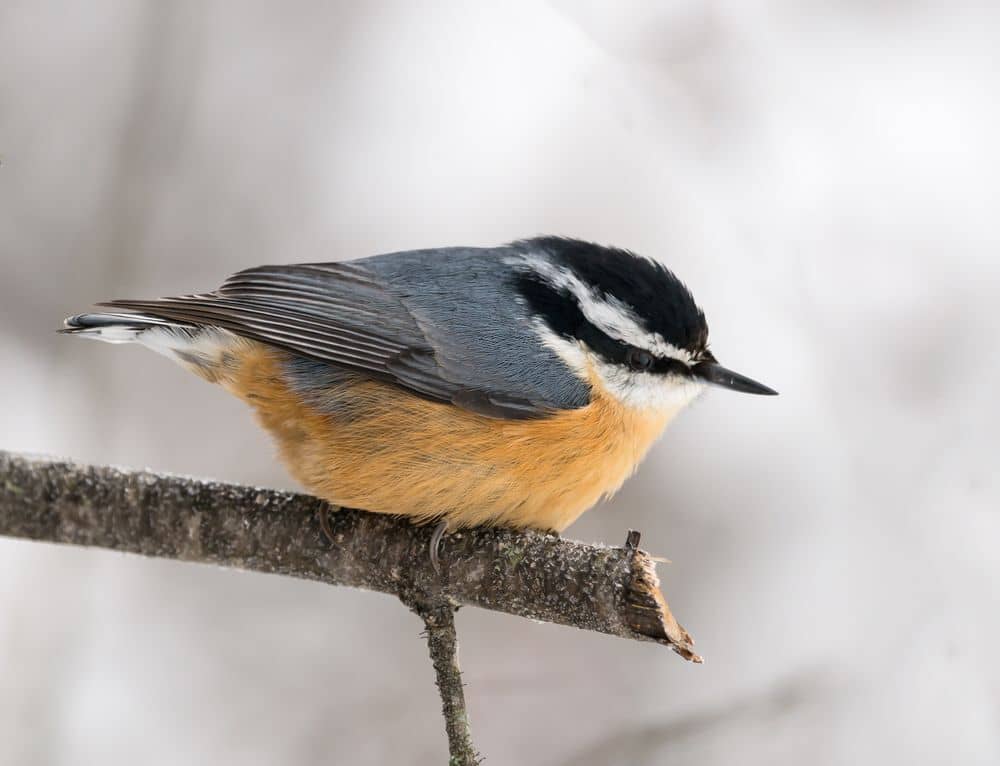
Red-breasted Nuthatch: The Tiny Acrobat with a Toy-Horn Call
Most backyard birdwatchers know the White-breasted Nuthatch. Its smaller cousin, the Red-breasted Nuthatch (Sitta canadensis), deserves a place on your seasonal watch list, too.
Look for a blue-gray back, rusty underparts, and a bold dark stripe through the eye beneath a white eyebrow. Then watch the performance: up the trunk, sideways along a branch, and headfirst down the bark. Listen for a nasal call that sounds like a miniature horn.
Red-breasted Nuthatches occur in some Pennsylvania breeding habitats, but winter visitors can make them much more noticeable at feeders. Their numbers vary widely. In an “irruption,” birds move beyond their usual range, often in response to northern food shortages. One winter you might see none; another could bring a regular visitor.
Watch conifers and mixed flocks of chickadees, and check your sunflower and suet feeders. These energetic birds can arrive well before snow, so there is no need to wait for winter to start looking.
Give Your Winter Guests a Warm Welcome
A welcoming yard offers more than a full feeder. Shrubs, evergreen cover, brush piles, fallen leaves, and standing seed heads provide places to forage and shelter. A little less fall tidying can leave a lot more for birds to explore.
Offer food at different levels. Sunflower seeds and suet serve many feeder visitors, while millet in a clean, low platform feeder can appeal to ground-feeding sparrows and juncos. Keep feeders clean, remove wet or spoiled seed, and provide fresh water when possible.
Most of all, look beyond the hanging feeder. Scan the ground, the base of a hedge, and the quiet woodland edge. Several of these guests do their best work just out of the spotlight.
Who Will Be Your First Winter Visitor?
This week, take your morning coffee to the window and give your backyard a closer look. Watch for the junco’s flashing tail, the tree sparrow’s rusty cap, or a White-throated Sparrow emerging from the brush.
Keep a simple list of first sightings. Over time, those dates can become your own backyard calendar, and a reminder that the changing seasons bring new reasons to look outside.
Summer’s visitors may be leaving, but the winter guest list is opening. Who will you spot first?

 ByBill