WildWatch Weekly Sparrows: The Little Brown Birds We Overlook Live Cams Donate Store Facebook YouTube The Little Brown Birds That Deserve a Second Look Discovering the remarkable diversity, hidden beauty, and seasonal journeys of Pennsylvania's most underappreciated backyard birds. When we think about our favorite backyard birds, we often picture the brilliant red of a Northern Cardinal, the beautiful blue of an Eastern Bluebird, or the bright yellow of an American Goldfinch. But what about...
Discovering the remarkable diversity, hidden beauty, and seasonal journeys of Pennsylvania’s most underappreciated backyard birds.
When we think about our favorite backyard birds, we often picture the brilliant red of a Northern Cardinal, the beautiful blue of an Eastern Bluebird, or the bright yellow of an American Goldfinch. But what about those little brown birds hopping around beneath our feeders, scratching through fallen leaves, or darting into the bushes when we approach? Most of us simply call them “sparrows” and don’t give them much thought.
But here’s something that might surprise you: not all sparrows are alike! Pennsylvania is home to a wonderful variety of sparrow species, each with its own personality, markings, songs, and seasonal habits. Some spend their entire lives here, while others travel hundreds or even thousands of miles between their breeding and wintering grounds. Some prefer our backyards, while others are secretive birds of open fields, grasslands, and woodland edges.
Sparrows may not have the flashy colors of some of our favorite songbirds, but take a closer look and you’ll discover beautiful patterns of chestnut, gray, black, white, and warm brown. Learning to recognize these subtle differences opens up an entirely new world of birdwatching. Let’s meet some of the sparrows you’re most likely to encounter here in Pennsylvania!
The Song Sparrow: A Familiar Voice Throughout the Year
One of Pennsylvania’s most familiar native sparrows is the Song Sparrow. This little bird can be found in brushy fields, gardens, wetlands, and along woodland edges. Song Sparrows have heavily streaked breasts, often with a noticeable dark spot in the center of the chest, and a relatively long, rounded tail. Although their brown plumage might seem ordinary at first glance, their beautiful, complex songs are anything but ordinary.
Male Song Sparrows are enthusiastic singers, often delivering a series of clear whistles followed by trills and buzzes from a favorite perch. What’s especially interesting is that individual males can learn several different song patterns. Their singing is an important way to establish territory and attract mates.
Song Sparrows can be found in Pennsylvania throughout the year, although many individuals migrate south in the fall while others remain or arrive from farther north. During winter, look for them in dense brush, along streams, and around backyard feeders. They often scratch through fallen leaves looking for seeds and insects, making them fun birds to watch even on the coldest days.
The Chipping Sparrow: A Summer Visitor With a Rusty Red Cap
The Chipping Sparrow is one of our most common warm-weather sparrows. If you’ve ever noticed a small, slender sparrow with a rusty red cap, a clean gray breast, and a thin black line running through its eye, you’ve probably spotted a Chipping Sparrow.
These friendly little birds are common around lawns, gardens, parks, and open woodlands. They’re often comfortable nesting near people and may build their tiny, cup-shaped nests in ornamental shrubs, evergreen trees, or other vegetation around homes. Their song is a long, dry trill that sounds almost like a tiny sewing machine running.
Chipping Sparrows are primarily spring and summer residents in Pennsylvania. They typically return in March or April to establish breeding territories, raise their young, and take advantage of the abundant insects available during warmer weather. By fall, most head south toward the southeastern United States, Mexico, and Central America. Their return each spring is another welcome sign that warmer days are ahead.
The White-throated Sparrow: A Beautiful Winter Visitor
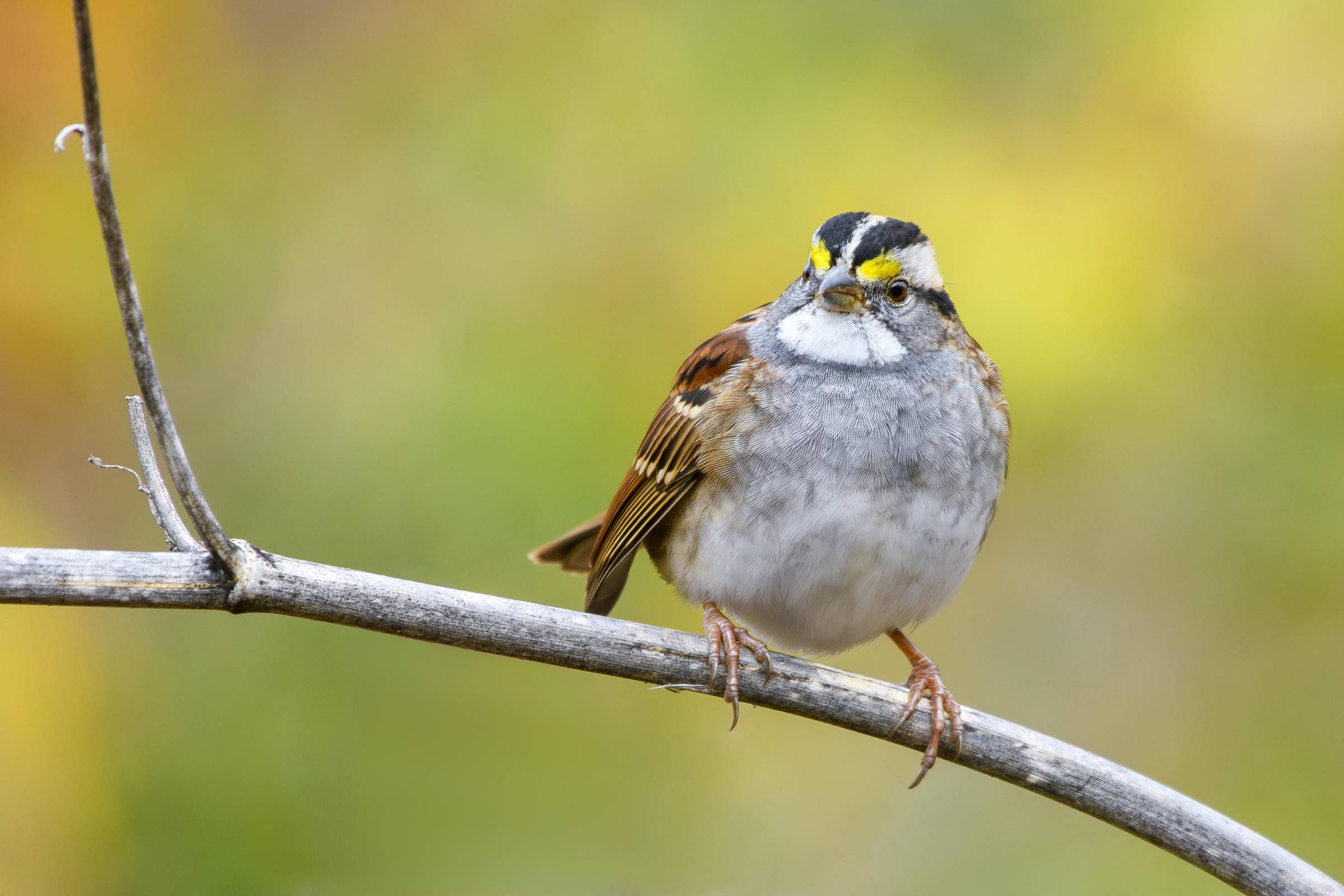
One of my favorite sparrows to watch during the colder months is the White-throated Sparrow. Unlike many of our brown sparrows, this bird has some striking markings that make identification a little easier. Look for its bright white throat, boldly striped head, and distinctive yellow patches between its eyes and bill. Some individuals have tan-and-brown head stripes rather than black-and-white ones.
White-throated Sparrows breed primarily in the northern forests of Canada and parts of the northeastern United States. As temperatures drop, many migrate south, making Pennsylvania an important wintering area. They’re especially common in brushy areas, woodland edges, and beneath backyard feeders from fall through spring.
These birds have one of the most memorable songs in the sparrow world, a series of clear, whistled notes often described as sounding like “Old Sam Peabody, Peabody, Peabody.” Although we associate their singing with their northern breeding grounds, you can sometimes hear them singing during spring migration right here in Pennsylvania. It’s a wonderful sound that reminds us how connected our backyards are to forests hundreds of miles away.
The White-crowned Sparrow: A Striking Migrant Passing Through
The White-crowned Sparrow is another beautiful sparrow that birdwatchers should keep an eye out for, especially during spring and fall migration. Adult birds have bold black-and-white stripes across the crown of their heads, giving them a very distinctive appearance. Young birds have brown-and-tan head stripes instead, which can make identification a little more challenging.
White-crowned Sparrows breed across northern Canada, Alaska, and mountainous regions of western North America. Many travel considerable distances to reach their wintering grounds. Here in Pennsylvania, they’re most commonly encountered during migration, particularly in April and May and again during October and November. Some also spend the winter in the state, although they’re less numerous than White-throated Sparrows.
Watch for these birds along brushy field edges, in weedy areas, and beneath feeders where seeds have fallen to the ground. They often move deliberately through low vegetation, stopping to scratch for food. Seeing one of these handsome travelers in your backyard is a reminder that even the smallest birds can undertake remarkable seasonal journeys.
The American Tree Sparrow: A Winter Guest From the Far North
As Chipping Sparrows head south for the winter, another little brown bird arrives to take their place. The American Tree Sparrow breeds in the far northern tundra and shrubby regions of Canada and Alaska, but spends its winters much farther south, including here in Pennsylvania. It’s sometimes nicknamed the “winter Chipping Sparrow” because the two species look surprisingly similar.
American Tree Sparrows have rusty-colored caps, a small dark spot in the center of their otherwise plain breasts, and a distinctive two-colored bill that’s dark on top and yellowish below. They’re especially fond of weedy fields, brushy areas, and places where native grasses and wildflowers have been allowed to produce seeds.
These hardy little birds are well adapted to cold weather. They often gather in small flocks, searching for seeds among dried vegetation and beneath snow-covered plants. If you maintain a backyard feeding station near open fields or brushy habitat, you may be lucky enough to attract these winter visitors. By early spring, they’ll begin their long journey north, eventually returning to breeding grounds far beyond Pennsylvania.
The Field Sparrow: A Gentle Voice of Our Grasslands
The Field Sparrow is a wonderful example of a bird that many people overlook simply because of where it lives. Rather than gathering around busy backyard feeders, Field Sparrows prefer open fields, grassy meadows, old pastures, and areas with scattered shrubs. They’re small, delicate-looking birds with a rusty crown, a pinkish bill, and a relatively plain, unstreaked breast.
What makes the Field Sparrow particularly special is its song. It begins with a series of clear, sweet whistles that gradually speed up, sounding much like a ping-pong ball bouncing faster and faster. Once you learn this distinctive song, you’ll begin recognizing Field Sparrows even when they’re hidden in the vegetation.
Field Sparrows are primarily spring and summer residents in Pennsylvania, returning as the weather warms and departing for more southern regions during fall. Some may remain through mild winters, especially in southern parts of the state. Unfortunately, these birds face challenges as open fields and brushy grasslands disappear through development or grow into mature forests. Protecting these transitional habitats is important for ensuring that future generations can enjoy their beautiful songs.
The Fox Sparrow: A Large Sparrow With a Surprising Talent
If you’ve ever spotted what looks like an unusually large, reddish-brown Song Sparrow scratching through leaves beneath a shrub, you may have encountered a Fox Sparrow. These handsome birds are among the largest sparrows regularly seen in Pennsylvania. Eastern Fox Sparrows have rich reddish-brown markings across their backs and tails, with bold reddish streaks and spots on their pale breasts.
One of their most entertaining behaviors is their enthusiastic scratching technique. Fox Sparrows use both feet to kick backward through leaves and loose soil, exposing seeds, insects, and other food hidden underneath. They can send leaves flying in every direction! It’s a behavior that’s fascinating to watch, particularly when one visits the ground beneath a backyard feeder.
Fox Sparrows are primarily migrants in Pennsylvania, appearing during spring and fall as they travel between northern breeding grounds and wintering areas farther south. A few may remain during winter, especially in suitable sheltered habitats. Although they’re often quiet and secretive while passing through, their rich, musical breeding song is considered one of the most beautiful among North American sparrows.
The House Sparrow: The Familiar Bird That Isn’t One of Our Native Sparrows
Here’s something that surprises many people: the House Sparrow, probably the sparrow most familiar to people living in towns and cities, isn’t closely related to our native North American sparrows at all! House Sparrows belong to a different bird family and were introduced to North America from Europe during the 1800s.
Male House Sparrows are fairly easy to recognize by their gray crowns, chestnut-colored necks, and black patches on their throats and upper breasts. Females are much plainer, with soft brown coloring and a pale stripe behind the eye. These birds are incredibly adaptable and can be found around buildings, farms, parking lots, shopping centers, and backyard feeders throughout Pennsylvania.
Unlike many of our native sparrows, House Sparrows remain in the same general area throughout the year. Unfortunately, their success has come at a cost to some native birds. House Sparrows aggressively compete for nesting cavities and can displace Eastern Bluebirds, Tree Swallows, and other cavity-nesting species. They’re a good reminder that not every familiar bird is native to our environment, and that understanding the differences between species matters for conservation.
Other Sparrows Worth Watching For
Swamp Sparrow
Found in marshes, wetlands, and damp brushy areas. These birds breed in Pennsylvania, and some remain through winter. Look for their rusty caps and gray faces.
Savannah Sparrow
A grassland bird with a streaked breast and often a yellowish patch near the eye. Commonly seen during the breeding season and migration, with occasional winter sightings.
There are still more sparrows to discover, including the secretive Lincoln’s Sparrow, which passes through Pennsylvania during migration, and the Grasshopper Sparrow, a small grassland specialist whose insect-like song can be difficult to hear. In fact, the Pennsylvania Game Commission reports that approximately 27 sparrow species have been documented in the state, including uncommon and rare visitors
Which Sparrows Stay, and Which Ones Migrate?
One of the most interesting things about Pennsylvania’s sparrows is how much our sparrow population changes with the seasons. Some species remain throughout the year, some arrive to breed during the warmer months, and others visit us primarily during winter. Spring and fall bring still more species passing through on migration.
Here’s a handy guide to some of our most familiar sparrows.
Sparrow species
Typical Pennsylvania occurrence
Song Sparrow
Year-round; some migrate
House Sparrow
Year-round
Swamp Sparrow
Breeds here; some winter
Chipping Sparrow
Mainly spring through fall
Field Sparrow
Mainly spring through fall
Savannah Sparrow
Mainly spring through fall
Grasshopper Sparrow
Spring and summer
White-throated Sparrow
Fall through spring; local breeders
American Tree Sparrow
Winter visitor
White-crowned Sparrow
Mainly spring and fall migration
Fox Sparrow
Mainly spring and fall migration
Lincoln’s Sparrow
Spring and fall migrant
These are general seasonal patterns, and individual birds don’t always follow the calendar. Some species that normally migrate may occasionally remain during mild winters, while others are present year-round because different populations move through the state at different times
The Next Time You See a Little Brown Bird…
The next time you’re watching your backyard feeders and notice a small brown bird hopping through the leaves, take an extra moment to look. Is it a Song Sparrow with its streaked chest? A White-throated Sparrow visiting from the northern forests? Perhaps an American Tree Sparrow spending the winter far from its Arctic breeding grounds?
What once looked like just another little brown bird might turn out to be a fascinating traveler, a talented singer, or a year-round neighbor you’ve been overlooking for years.
That’s one of the wonderful things about watching wildlife. Sometimes the most interesting discoveries aren’t the rarest or most colorful animals. Sometimes they’re the familiar little creatures that have been right in front of us all along.
So this week, I encourage you to give our sparrows a little extra attention. You might be surprised by just how beautiful and interesting these overlooked birds really are!

 ByBill