Small Birds Worth a Closer Look
A little movement in the branches. A soft call from an evergreen. A tiny bird that appears for a moment, then disappears behind a cluster of leaves. During a fall walk, it is easy to overlook a kinglet, but once you notice one, you may find yourself stopping to watch every busy branch.
Golden-crowned and Ruby-crowned Kinglets are smaller than chickadees, with rounded bodies, delicate bills, and seemingly endless energy. They hop, flutter, and reach through the foliage in search of food, rarely staying still long enough to give binoculars, or a camera, an easy target. Their restless movements are part of their charm.
For many people, these birds are an unfamiliar part of fall migration. Yet October offers a wonderful opportunity to discover them here in southwestern Pennsylvania. One wears a bright golden crown framed by bold stripes. The other carries a ruby surprise that often stays completely hidden.
When Do Kinglets Arrive?
In Pennsylvania, Ruby-crowned Kinglets generally move through during late September and October. For Pittsburgh-area birdwatchers, October is an especially good month to look for them as they pause to feed on their journey south. Most continue onward by early November, although a few linger or spend the winter in parts of the state.
Golden-crowned Kinglets become more noticeable around the Pittsburgh region as fall migrants arrive in late September and early October. Unlike most Ruby-crowned Kinglets, many golden-crowns remain through winter, giving us opportunities to see them long after the autumn leaves have fallen. They are among the small birds that make a cold-weather woodland walk worth taking.
The two species have different seasonal patterns because they do not spend winter in exactly the same places. Most Ruby-crowned Kinglets winter in the southern and southwestern United States and Mexico, while Golden-crowned Kinglets can remain much farther north. Arrival dates vary with location and conditions, so think of October as a promising window rather than a fixed appointment.
The Golden-crowned Kinglet: A Tiny Bird with a Brilliant Crown
The Golden-crowned Kinglet has a face that looks carefully outlined. A pale eyebrow and dark eye stripe create a bold pattern, while black stripes frame the colorful crown. Adult females have a yellow crown; adult males have an orange center within the yellow, sometimes revealed more clearly when the crown feathers rise. Its olive-toned back and pale underside help it blend into the surrounding branches.
Look for golden-crowns working through evergreens, especially dense stands of hemlock, spruce, or pine. They often search high in the branches, picking tiny prey from needles and twigs. Occasionally, one briefly hovers to reach a morsel, offering a glimpse of just how agile these little birds can be. During migration, they also use deciduous woods, parks, and backyards.
Their winter presence is especially remarkable because they rely heavily on small animal prey. Even when a woodland seems quiet and lifeless, Golden-crowned Kinglets search for insects and other tiny arthropods tucked into bark and foliage. Watching one work through a winter evergreen is a reminder that a tree can hold far more life than we can easily see.
The Ruby-crowned Kinglet: A Hidden Flash of Red
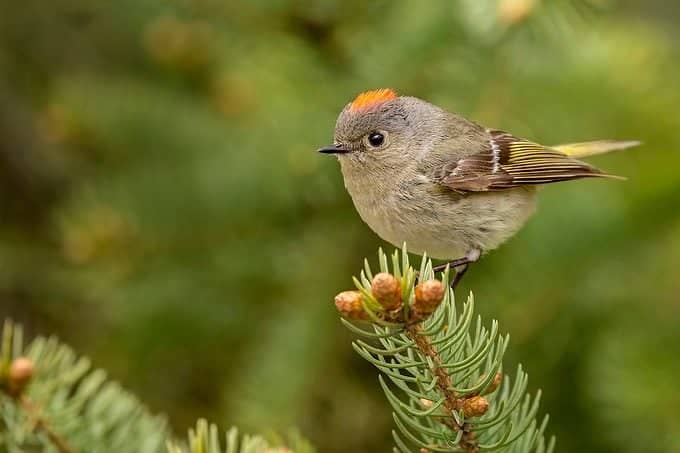
The Ruby-crowned Kinglet is a lesson in looking beyond a bird’s name. Only the male has the red crown patch, and even he usually keeps it concealed beneath surrounding feathers. You can get an excellent look at a Ruby-crowned Kinglet without seeing any red at all. When an excited male raises those feathers, however, the sudden flash of color is memorable.
More dependable identification clues are its relatively plain olive-green face, prominent white eye ring, and pale wing bar with a dark bar directly below it. Watch its behavior, too: Ruby-crowned Kinglets repeatedly flick their wings as they move through shrubs and branches. That quick little motion can help you recognize one before you have seen every feather detail.
During migration, ruby-crowns often forage in lower and middle vegetation, making them easier to watch at eye level than their golden-crowned relatives. They search for insects and spiders but also eat some fruit and seeds. Wooded edges, tangled shrubs, and leafy park trails can all provide useful feeding places during their journey.
There is another surprise tucked inside this small bird: its voice. The Ruby-crowned Kinglet’s song is surprisingly loud and elaborate for such a tiny singer. Although its full song is more associated with spring, learning it gives you another reason to look forward to the bird’s return next year.
How to Find Kinglets on Your Next Walk
Start with habitat. For Golden-crowned Kinglets, give evergreen trees a careful look, including the higher branches and outer needle clusters. For Ruby-crowned Kinglets, spend time scanning shrubs, woodland edges, and lower branches. Neither species follows these preferences rigidly, so keep watching whenever a tiny bird moves through the foliage.
Pay attention to groups of feeding birds. Kinglets often travel with mixed flocks during migration and winter, so a busy patch of woodland deserves a pause. Rather than immediately following the largest or most obvious bird, check the smaller movements around it. A kinglet may be quietly feeding just a few branches away.
Listening can help, especially with Golden-crowned Kinglets. Their calls are thin and very high-pitched, sometimes revealing birds hidden in dense foliage. If you cannot hear them easily, watch for movement instead: a trembling twig, a brief flutter, or a small shape darting between needle clusters can lead you to the bird.
Once you locate one, stop and let it move through your field of view. Keep your eyes on the bird before raising your binoculars, and notice a nearby branch or leaf as a reference point. Trying to chase every hop can be frustrating; letting the bird come into view often makes the experience more enjoyable.
Making Your Yard a Useful Stopover
A kinglet may visit your yard without ever landing on a feeder. Both species search vegetation for small prey, and migrating birds can find feeding opportunities in trees and shrubs close to our homes. A quiet corner with several layers of vegetation may offer more to a passing kinglet than an open lawn.
Think about your yard as a place to explore. Watch evergreen branches, check shrubs along the property edge, and spend a few minutes looking out at trees that you normally pass without noticing. A bird’s brief stop might be happening right outside your window.
You also do not need to see the crown to enjoy the encounter—or identify the bird. A boldly striped face points toward a Golden-crowned Kinglet. A prominent white eye ring, plainer face, and repeated wing flicks suggest a Ruby-crowned Kinglet. Those everyday details are often more useful than waiting for a perfect flash of gold or red.
Look Closely This October
Fall birdwatching often draws our attention upward to migrating hawks or outward to colorful flocks. Kinglets invite us to slow down and look into the branches immediately around us. Their small size makes them easy to miss, but their constant activity makes them delightful to watch.
This week, take a little extra time along a woodland trail or beside the trees in your backyard. Pause where the branches seem busy. You may discover a golden crown among the needles, or a wing-flicking visitor carrying a hidden ruby.
Have you spotted either kinglet this fall? We would love to hear which species you found and where you saw it. Sometimes the smallest birds leave the biggest impression.

 ByBill