The Belted Kingfisher: The Incredible Bird That Dives Like a Missile and Nests Underground
WildWatch Weekly The Belted Kingfisher: The Incredible Bird That Dives Like a Missile and Nests Underground Live Cams Donate Store Facebook YouTube The Belted Kingfisher Imagine standing beside a quiet Pennsylvania stream on a crisp November morning. The water is flowing gently, the trees are nearly bare, and everything seems peaceful. Suddenly, a loud, rattling call breaks the silence. A flash of blue-gray streaks across the water, and a bird with a shaggy crest lands on a branch overlooking...
Imagine standing beside a quiet Pennsylvania stream on a crisp November morning. The water is flowing gently, the trees are nearly bare, and everything seems peaceful. Suddenly, a loud, rattling call breaks the silence. A flash of blue-gray streaks across the water, and a bird with a shaggy crest lands on a branch overlooking the stream.
You’ve just encountered one of North America’s most fascinating birds: the Belted Kingfisher.
With its oversized head, dagger-like bill, and remarkable fishing abilities, the Belted Kingfisher looks almost prehistoric. But what makes this bird truly extraordinary isn’t just how it catches fish. It’s how it builds its nest, raises its young, defends its territory, and survives in a world where a successful meal requires incredible precision.
This week, we’re taking a closer look at a bird many people have heard without ever realizing what they were listening to.
Meet the Belted Kingfisher: A Bird Unlike Any Other
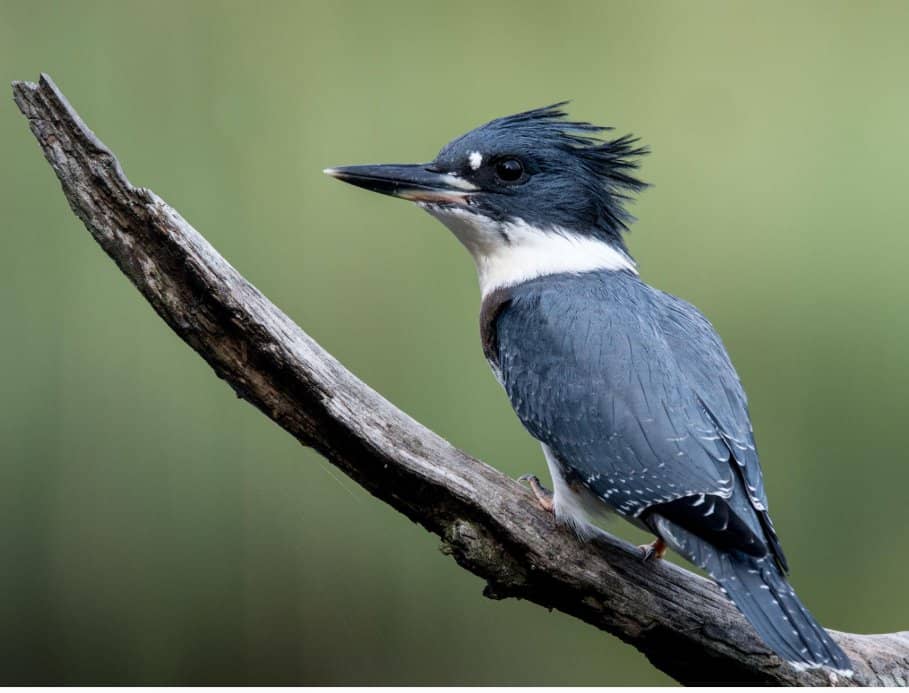
The Belted Kingfisher (Megaceryle alcyon) is a stocky, medium-sized bird measuring approximately 11–14 inches long, with a wingspan of around 19–23 inches. Its most recognizable features are its large head, wild-looking crest, short legs, and long, straight bill.
Male Belted Kingfisher
Its blue-gray back and wings contrast beautifully with a bright white collar and belly. Both males and females have a blue-gray band across their chests, but there’s something unusual about the female.
Female Belted Kingfisher
Unlike most North American birds, where males tend to be more colorful, female Belted Kingfishers are actually more colorful than males! Females have an additional rusty, reddish-brown band across their bellies and along their sides. Males lack this extra splash of color.
But perhaps the easiest way to identify a kingfisher is by its voice. Its loud, mechanical, rattling call sounds almost like a rapid-fire machine gun. If you’ve spent time fishing, kayaking, or walking beside streams, there’s a good chance you’ve heard this distinctive sound.
Kingfishers are often heard before they’re seen, especially when one comes speeding around a bend in a creek.
An Amazing Hunter: Diving Headfirst for Dinner
Watching a Belted Kingfisher hunt is one of nature’s great spectacles.
Unlike herons, which patiently wade through shallow water, kingfishers typically hunt from above. They’ll perch on a branch, utility wire, or other elevated lookout with a clear view of the water below.
Their exceptional eyesight allows them to spot small fish swimming beneath the surface. Once a target is located, the kingfisher launches itself into the air, points its bill downward, and plunges headfirst into the water.
Sometimes they’ll hover in midair before diving, beating their wings rapidly while keeping their eyes locked on a fish below.
The entire event can happen in seconds.
A successful kingfisher emerges with a fish gripped firmly in its powerful bill. It then flies back to a perch, where the real work begins.
Rather than swallowing its catch immediately, the bird often beats the fish against a branch or other hard surface. This helps subdue the prey and position it for swallowing.
The fish is generally swallowed headfirst, making it easier for the fins and scales to pass down the bird’s throat.
Although fish make up most of their diet, Belted Kingfishers also eat crayfish, aquatic insects, frogs, and occasionally other small animals.
And here’s another fascinating detail: kingfishers must account for the way light bends when passing from air into water. This refraction makes fish appear to be in a slightly different position than they really are. Their hunting behavior allows them to compensate for this optical illusion.
A Nest Underground? The Kingfisher’s Remarkable Home
Most people picture birds building nests in trees, shrubs, or nest boxes. The Belted Kingfisher does something completely different.
It digs a tunnel into the side of a dirt bank!
During the breeding season, kingfishers search for steep, exposed banks, often along rivers, streams, lakes, or gravel pits. These locations provide the perfect opportunity to excavate a nesting burrow.
Using their powerful bills to loosen soil and their feet to push the dirt backward, both the male and female help dig a horizontal tunnel into the bank.
The tunnel is typically 3–6 feet long, although some can extend considerably farther. At the far end, the birds create a slightly enlarged chamber where the female will lay her eggs.
Think about that for a moment. A bird weighing only a few ounces can excavate a tunnel several feet into solid earth!
The entrance is usually just large enough for the birds to squeeze through. This underground nesting strategy provides protection from weather and many predators, although burrows can still be vulnerable to flooding, collapse, and animals capable of reaching the nest.
Unlike many songbirds, kingfishers don’t construct a soft nest of grass, feathers, or twigs. The eggs are laid directly on the floor of the chamber. As the nesting season progresses, the chamber can accumulate fish bones, scales, and other remains from the family’s meals.
It may not sound like the most comfortable nursery, but it works remarkably well for these specialized birds.
Raising a Family: Life Inside the Kingfisher Tunnel
Once their underground home is complete, the female typically lays five to eight glossy white eggs.
Both parents participate in incubation, which lasts approximately 22–24 days. During this time, the adults take turns keeping the eggs warm and guarding their nesting territory.
When the chicks hatch, they’re helpless, blind, and almost completely naked. They depend entirely on their parents for food and protection.
And feeding a growing family of kingfishers is no small task!
Both parents spend their days catching fish and delivering meals into the dark nesting tunnel. As the chicks grow, their appetites increase dramatically.
Imagine having six or seven hungry youngsters underground, all waiting for their next fish dinner!
The young remain inside the burrow for roughly four weeks before emerging into the outside world. By this time, they’re well feathered and capable of flight, but their education is far from over.
The parents continue feeding them for a period after they leave the nest, while the youngsters develop the skills needed to catch fish independently.
Learning to become a successful kingfisher requires practice. Young birds must master the art of spotting prey, judging distances, diving accurately, and handling slippery fish.
Eventually, the family separates, and the young birds establish lives of their own.
A Fiercely Territorial Bird
Despite their relatively small size, Belted Kingfishers have enormous personalities.
They’re highly territorial, especially around productive fishing areas and nesting sites. A kingfisher that discovers another bird entering its territory may respond with loud rattling calls, aggressive flights, and determined chases.
It’s not unusual to see two kingfishers racing along a creek, calling loudly as one attempts to drive the other away.
Outside the breeding season, these birds are generally solitary. A good stretch of fishing water is valuable real estate, and a kingfisher doesn’t necessarily want to share it.
This territorial behavior also explains why you might regularly see a kingfisher perched on the same branch along your favorite creek. Once a bird finds a productive hunting location, it may return to that lookout again and again.
Where Can You Find a Belted Kingfisher?
Here’s the good news: you don’t need to travel to a remote wilderness to see one.
Belted Kingfishers are widespread throughout North America and can be found in a surprising variety of habitats, as long as there’s suitable water and a dependable food supply.
Look for them along rivers, streams, lakes, ponds, reservoirs, wetlands, and even coastal shorelines. They particularly favor places with relatively clear water, where fish are easier to spot from above.
In Pennsylvania, kingfishers are regular sights along many waterways. Here in western Pennsylvania, rivers such as the Allegheny, Youghiogheny, and Kiskiminetas, along with smaller creeks and lakes, provide the kinds of habitats they use.
And November is still a great time to look for them!
Many Belted Kingfishers move south as northern waters freeze, but some remain in Pennsylvania through the winter wherever open water and fish are available.
In fact, late fall and winter can make kingfishers easier to spot. With leaves disappearing from streamside trees, their favorite perches become much more visible.
If you want to find one, start by listening. That unmistakable rattling call often gives away their location long before you spot the bird.
Then scan exposed branches, fallen trees, wires, and other perches overlooking the water. You may notice a blue-gray bird sitting motionless, staring intently at the surface below.
Be patient. If you watch long enough, you might witness one of its spectacular fishing dives.
Five Incredible Kingfisher Facts That Might Surprise You
As remarkable as their fishing and nesting habits are, Belted Kingfishers have even more surprises.
1 Their babies can digest fish bones!
Young kingfishers have unusually acidic stomachs that help them digest fish bones, scales, and other hard materials. As they mature, their digestive systems change, and they begin regurgitating indigestible material in pellets, somewhat like owls do. All About Birds+1
2. Their nesting tunnels can be astonishingly long.
Although most burrows are 3–6 feet long, some have been recorded reaching 15 feet into a bank. That’s an extraordinary excavation project for a bird that weighs only about five or six ounces! Audubon+1
3. Parents may actually teach their youngsters to fish.
One of the most fascinating observations involves adult kingfishers dropping food into the water near their fledglings, apparently encouraging the youngsters to practice retrieving it. It’s an incredible example of how young birds can develop essential survival skills with help from their parents. Commonwealth of Pennsylvania+1
4. They’ve been around for a very long time.
Fossils of Belted Kingfishers dating back hundreds of thousands of years have been discovered in North America. Their ancestors were catching fish long before humans began building cities and roads along our rivers. All About Birds
5. They sometimes travel far beyond their normal range.
Although Belted Kingfishers are native to North America, wandering individuals have appeared in places as distant as Iceland, Greenland, the British Isles, and even the Galápagos Islands. For a bird we associate with our local streams, that’s some impressive traveling!
Why Healthy Streams Matter to Kingfishers
The Belted Kingfisher is more than just an entertaining bird to watch. It’s also a wonderful reminder of how important healthy waterways are to wildlife.
Kingfishers depend on productive aquatic habitats where fish and other prey are available. They also need suitable earthen banks for nesting, along with perches overlooking the water.
Pollution, sediment runoff, erosion, and changes to streambanks can make these habitats less suitable. In some areas, development removes the steep banks kingfishers need for their underground nests.
Interestingly, human activities sometimes create new nesting opportunities. Gravel pits, sand excavations, and road cuts can provide exposed banks where kingfishers establish burrows.
But protecting natural stream corridors remains important. Maintaining healthy waterways, preserving vegetation along streams, and limiting disturbance near active nesting sites all help these birds thrive.
And while a kingfisher’s presence doesn’t automatically mean a stream is pollution-free, seeing one hunting successfully is a wonderful reminder that the water supports a food web of fish and other aquatic life.
The Next Time You’re Near the Water, Look for the Kingfisher!
There’s something special about discovering a bird that doesn’t behave quite like any other.
The Belted Kingfisher doesn’t visit your backyard seed feeder. It doesn’t build a cup-shaped nest in your favorite tree. And it certainly doesn’t spend much time singing a beautiful melody.
Instead, it patrols our waterways like a tiny, feathered fighter jet, diving into the water to catch fish, digging remarkable underground tunnels, and raising its family in a hidden chamber beneath the earth.
It’s a bird of incredible adaptations, surprising behaviors, and unmistakable personality.
So the next time you’re walking beside a creek, fishing along a river, or enjoying a peaceful afternoon near a lake, listen for that loud, rattling call.
Look toward the water, and you might catch a flash of blue-gray speeding past.
And if you’re especially lucky, you’ll get to watch one of North America’s most remarkable birds plunge headfirst into the water and emerge with its next meal.
The Belted Kingfisher is proof that some of nature’s most incredible wildlife can be found right in our own backyards — if we know where to look.
Until next time, keep your eyes on the skies, your ears tuned to nature, and enjoy the incredible wildlife around you!

 ByBill