Things That Go Bump in the Night: Meet Nature’s Halloween Creatures
WildWatch Weekly Things That Go Bump in the Night: Meet Nature's Halloween Creatures Live Cams Donate Store Facebook YouTube Things That Go Bump in the Night: Meet Nature's Halloween Creatures WildWatch Weekly | A Special Halloween Edition It's Halloween! The pumpkins are glowing, the leaves are rustling, and something mysterious is moving through the darkness. Somewhere in the woods, an owl lets out an eerie call. A bat swoops silently overhead. A spider waits in the shadows of its web, and...
Things That Go Bump in the Night: Meet Nature’s Halloween Creatures
WildWatch Weekly | A Special Halloween Edition
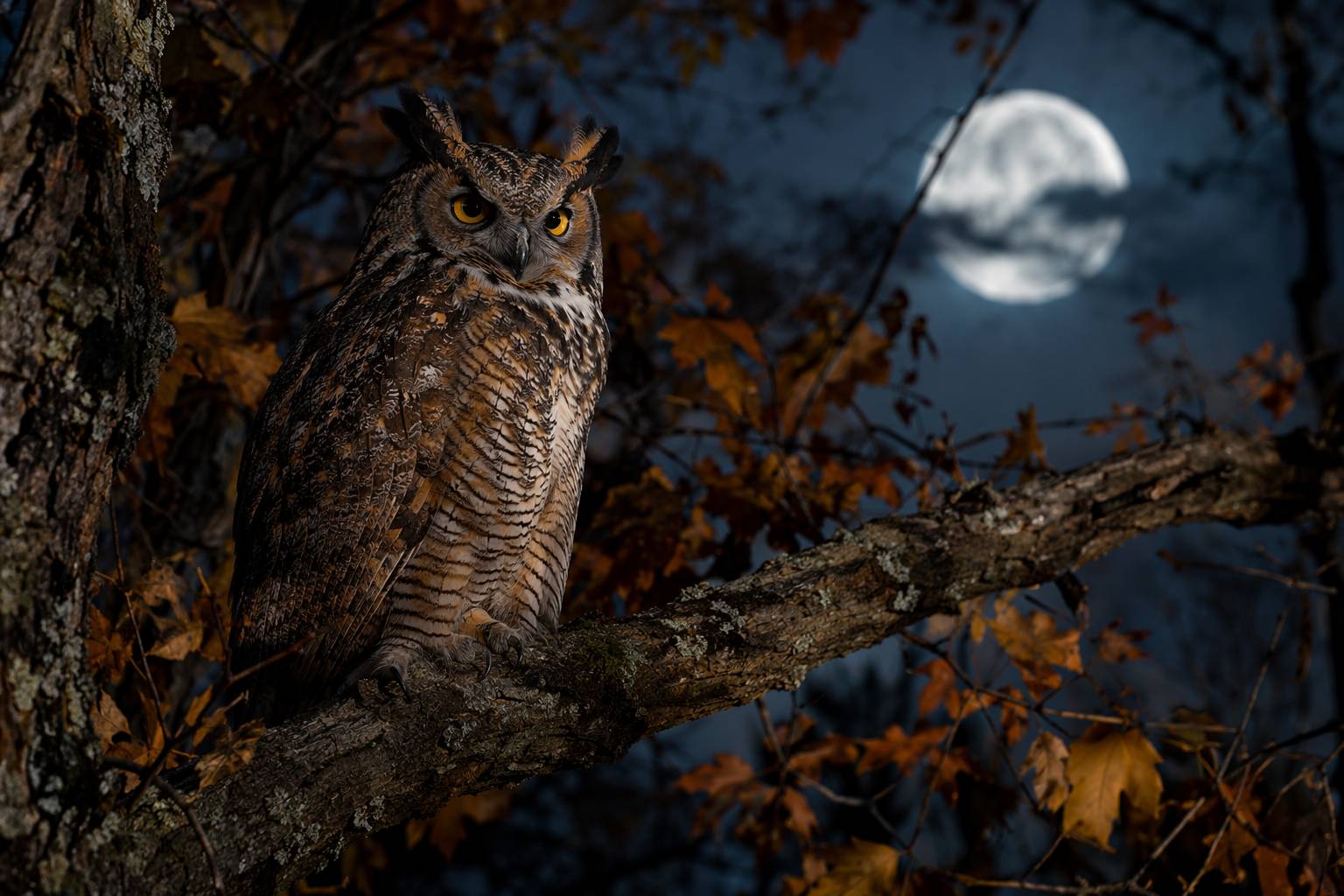
It’s Halloween! The pumpkins are glowing, the leaves are rustling, and something mysterious is moving through the darkness. Somewhere in the woods, an owl lets out an eerie call. A bat swoops silently overhead. A spider waits in the shadows of its web, and a strange pair of eyes reflects the moonlight from the edge of your backyard.
Sounds like the opening scene of a scary movie, doesn’t it?
But here’s the real surprise: some of nature’s most misunderstood creatures are the very animals that make Halloween so much fun! For centuries, owls, bats, ravens, spiders, and other nighttime visitors have inspired spooky stories, superstitions, and legends. Yet behind their frightening reputations are some truly remarkable adaptations that help them survive in the wild.
So grab your flashlight, pull on your favorite Halloween sweater, and join us for a moonlit adventure into the fascinating world of nature’s Halloween creatures. You might discover that the things that go bump in the night aren’t nearly as scary as you think!
Owls: The Ghostly Hunters of the Night
Imagine walking through a quiet forest after sunset when suddenly you hear a long, haunting call echoing through the trees. Hoooo-hoo-hoo-hooooo! Your imagination might suggest a ghost, but chances are you’ve just heard one of nature’s most impressive nighttime predators.
Owls have been associated with Halloween, witches, and mysterious spirits for hundreds of years. Their large, forward-facing eyes, ability to turn their heads an astonishing distance, and almost supernatural silence in flight have earned them a starring role in spooky folklore around the world.
But there’s some fascinating science behind their ghostly abilities. Many owls have specialized feathers that reduce the noise produced by their wings, allowing them to approach prey with remarkably little sound. Their facial disks help direct sound toward their ears, making them extraordinary listeners. Some species can locate small mammals in near-total darkness simply by listening for movement beneath leaves or snow.
And about that famous head-turning trick? Owls can’t actually rotate their heads all the way around, but many can turn them approximately 270 degrees! This remarkable flexibility helps compensate for eyes that are largely fixed in their sockets.
Here in Pennsylvania, Great Horned Owls, Barred Owls, Eastern Screech-Owls, and Barn Owls are among the species that bring mystery to our nighttime landscapes. Eastern Screech-Owls are particularly interesting because, despite their name, their calls are often soft trills or descending whinnies rather than the terrifying screams you might expect.
Halloween fun fact: The Barn Owl’s pale, heart-shaped face and eerie, raspy screeches may have helped inspire old stories about ghosts haunting barns and abandoned buildings. Imagine hearing one in the darkness before anyone understood what made that sound!
Bats: The Real Vampires of Halloween?
No Halloween decoration collection would be complete without a few bats flying across the moon. Their dark wings, nighttime habits, and mysterious movements have made them symbols of vampires and haunted houses. But the bats flying around Pennsylvania are much more interested in catching insects than frightening people.
In fact, bats are among the most beneficial animals in our nighttime skies. Many species consume large quantities of flying insects, including moths, beetles, and mosquitoes. They play an important role in controlling insect populations and maintaining healthy ecosystems.
One of their most extraordinary abilities is echolocation. Many bats navigate and hunt by producing high-frequency sounds and listening to the echoes that bounce back from nearby objects. It’s like having a built-in sonar system! These sounds are generally too high-pitched for human ears to detect, but specialized ultrasonic microphones can record them.
At PixCams, we’ve been exploring this hidden world through our BirdNET-Cloud technology, which can use ultrasonic recordings to help identify bat activity. It’s fascinating to think that while we’re sitting outside enjoying a quiet autumn evening, bats may be having an incredibly busy conversation in frequencies we cannot hear.
And what about vampire bats? They really do exist, but only three living species feed on blood, and they are native to parts of Mexico and Central and South America. None of Pennsylvania’s native bats are vampires!
As Halloween arrives and temperatures drop, many of our local bats are preparing for winter. Some species migrate, while others seek protected places to hibernate. Their greatest concern isn’t finding a neck to bite. It’s finding enough energy and a safe place to survive the cold months ahead.
Halloween fun fact: A bat’s wings are actually modified hands! The thin wing membrane stretches between elongated finger bones, making bats the only mammals capable of true, sustained flight.
Spiders: The Eight-Legged Architects of Halloween
Cobwebs hanging from doorways, giant plastic spiders crawling across porches, and enormous webs stretched between trees are classic Halloween decorations. But the real spiders living around our homes are far more interesting than their oversized plastic cousins.
Spiders are among nature’s most talented engineers. Orb-weaving spiders construct intricate webs using silk produced by specialized glands in their bodies. Different kinds of silk serve different purposes, including strong structural supports and sticky threads designed to capture unsuspecting insects.
Have you ever stepped outside on a cool autumn morning and discovered a beautiful spiderweb covered in tiny droplets of dew? These delicate structures can look like sparkling works of art. Some orb-weavers even rebuild much of their web regularly, often during the evening or nighttime hours.
Although spiders are often portrayed as dangerous monsters, most species encountered around Pennsylvania homes and gardens pose little threat to people. Instead, they provide a valuable service by catching flies, mosquitoes, moths, and other small insects.
One of autumn’s most impressive spiders is the yellow garden spider, sometimes called the writing spider. Its large circular web may feature a distinctive zigzag pattern of silk down the center. Scientists are still studying all the reasons for this unusual decoration, but it certainly makes the web look mysterious!
Halloween fun fact: Spider silk is remarkably strong for its weight, and researchers study its properties to develop new materials. Nature invented this incredible fiber long before humans started making artificial webs for Halloween!
Ravens and Crows: The Mysterious Birds of Dark Omens
Picture a dark bird perched on a twisted tree branch, calling loudly beneath a cloudy October sky. It’s easy to understand why ravens and crows have become associated with witches, haunted castles, and ominous predictions.
Their black feathers, deep calls, and tendency to gather around unusual food sources have contributed to centuries of spooky folklore. Edgar Allan Poe’s famous poem The Raven certainly helped cement the raven’s reputation as one of literature’s most mysterious birds.
But these birds have something far more impressive than a frightening appearance: extraordinary intelligence.
Crows can recognize individual human faces, remember people they associate with danger, and communicate information about threats to other crows. Some members of the crow family use tools, solve complicated problems, and demonstrate remarkable abilities to learn from experience.
Ravens are equally fascinating. They engage in playful behaviors, manipulate objects, and can solve challenging puzzles. Researchers have documented sophisticated social interactions among these birds, suggesting that their intelligence rivals that of some mammals in certain tasks.
Here in Pennsylvania, American Crows are familiar residents of neighborhoods, fields, and forests. Common Ravens are also found throughout the state, particularly in wooded and mountainous areas. While the two can look similar, ravens are generally larger, have heavier bills, and produce deeper, more resonant calls.
And if you’ve ever watched a group of crows mobbing an owl or hawk, you know they aren’t easily frightened. In fact, they may be the ones doing the scaring!
Halloween fun fact: A group of crows is traditionally called a “murder,” while a group of ravens may be called an “unkindness.” Those colorful collective names sound perfect for Halloween, although they aren’t scientific descriptions of the birds’ behavior!
Opossums: The Walking Dead of the Animal Kingdom
What’s scarier than encountering a strange creature wandering through your backyard at midnight? How about one that suddenly drops to the ground, opens its mouth, and appears to die right in front of you?
Meet the Virginia Opossum, one of North America’s most unusual mammals and perhaps nature’s greatest Halloween actor.
Opossums are primarily nocturnal, which means they’re most active after dark. With their pale faces, pointed snouts, long hairless tails, and mouths full of sharp-looking teeth, they can appear rather intimidating when illuminated by a flashlight.
But their famous defense mechanism is what really makes them Halloween superstars.
When severely frightened, an opossum may enter an involuntary, deathlike state. Its body becomes limp, its mouth may hang open, and it can even release a foul-smelling fluid that helps make the performance convincing. This behavior, commonly called “playing possum,” isn’t simply a clever trick the animal chooses to perform. It’s an automatic physiological response to extreme stress.
And here’s another surprise: Virginia Opossums are North America’s only native marsupials found north of Mexico. Like kangaroos, female opossums carry their developing young in a pouch. As the babies grow, they may ride around clinging to their mother’s back, creating one of the most unusual family portraits in the animal kingdom.
Despite their spooky appearance, opossums are generally shy animals that would rather avoid confrontation. They are opportunistic omnivores, feeding on insects, fruits, carrion, and a wide variety of other foods.
Halloween fun fact: Opossums have 50 teeth, more than any other native North American land mammal! That toothy grin might look frightening, but it’s usually just a warning to leave them alone.
Foxes and Coyotes: The Eerie Voices in the Darkness
You’re sitting beside a backyard fire on a chilly October evening when suddenly a bloodcurdling scream comes from the woods. It sounds almost human. Is someone in trouble? Is there a ghost wandering through the trees?
Before you start calling the Ghostbusters, consider another possibility: you may have just heard a fox.
Red Foxes produce a surprising variety of vocalizations, including sharp barks, screams, and high-pitched calls that can sound downright terrifying to anyone unfamiliar with them. Some of these calls are particularly common during the winter breeding season, but foxes communicate throughout the year.
Coyotes are another source of mysterious nighttime sounds. Their yips, barks, howls, and group vocalizations can create the impression that an enormous pack is roaming nearby. In reality, a small number of coyotes can produce an astonishing amount of noise.
Both foxes and coyotes are important predators in Pennsylvania’s ecosystems. They help regulate populations of rodents and other small animals while adapting remarkably well to forests, farmland, and even suburban neighborhoods.
These animals aren’t announcing the arrival of Halloween monsters. They’re communicating with family members, defending territories, and navigating their daily lives.
Halloween fun fact: A chorus of just a few coyotes can sound like a much larger gathering because of their varied, overlapping calls. It’s nature’s very own spooky sound-effects department!
Moths: The Ghosts That Flutter Around Your Porch Light
When we think of Halloween wildlife, moths might not immediately come to mind. But these mysterious nighttime flyers have inspired their own share of supernatural legends.
Perhaps the most famous is the Death’s-head Hawkmoth, a group of moth species known for the skull-like markings on their thoraxes. These remarkable insects have appeared in folklore, literature, and horror films because of their unusual appearance. Although they aren’t native to Pennsylvania, they’re a perfect example of how an animal’s appearance can inspire spooky stories.
Closer to home, Pennsylvania has an incredible diversity of moths, including large silk moths, sphinx moths, and countless smaller species. Many are active after sunset, navigating the darkness using environmental cues and their sensitive sensory systems.
You may notice moths fluttering around porch lights on warm autumn evenings. Artificial lighting can disrupt the natural orientation behaviors of some nighttime insects, sometimes causing them to circle or become trapped near lights.
And while moths might seem like less glamorous relatives of butterflies, they’re incredibly important to wildlife. Many serve as pollinators, and their caterpillars provide essential food for songbirds and other animals.
Halloween fun fact: Some moths can detect the ultrasonic calls of hunting bats and respond with evasive maneuvers. Imagine having a built-in alarm system that warns you when a predator is approaching through the darkness!
Happy Halloween from PixCams!
As Halloween arrives, remember that the natural world is filled with creatures far more fascinating than anything we could invent for a haunted house.
The owl calling from the treetops isn’t a ghost. The bat flying overhead isn’t a vampire. The spider waiting in its web isn’t plotting against you, and the opossum wandering through your yard isn’t auditioning for the next zombie movie.
They’re simply wild animals doing what they do best: surviving, adapting, and playing their unique roles in the incredible world around us.
So enjoy the pumpkins, costumes, candy, and spooky decorations this weekend. But when darkness falls and you hear something go bump in the night, remember that you might just be sharing your neighborhood with one of nature’s most extraordinary Halloween creatures.
Happy Halloween, and happy wildlife watching from all of us at PixCams!
Until next week, keep your eyes on the skies, your ears tuned to nature, and your curiosity alive. You never know what amazing wildlife might be waiting just outside your door!

 ByBill