Step outside in the Pittsburgh area today and the change is difficult to miss. The sky has lost some of its familiar summer blue, distant hills look faded, and the air may carry the faint smell of something burning, even though the fires are hundreds of miles away.
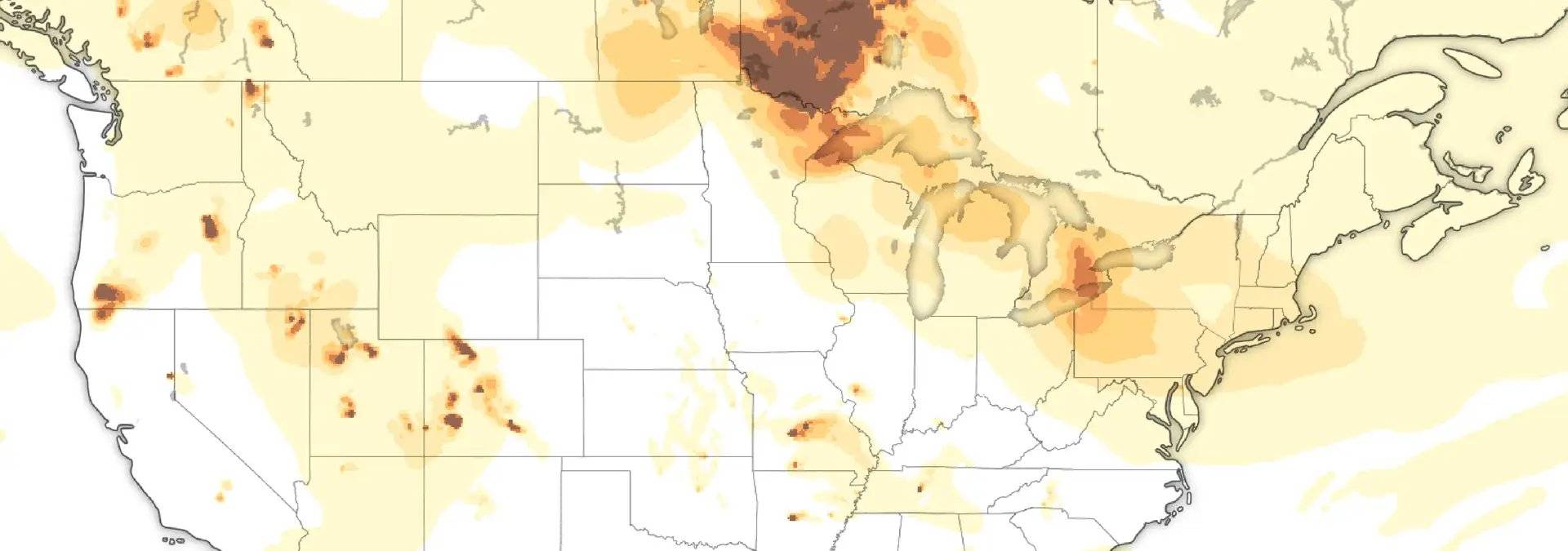
Smoke from Canadian wildfires has moved into Western Pennsylvania, sharply reducing air quality and prompting alerts across the region. It is a powerful reminder that the atmosphere connects us in ways that maps and borders cannot contain. A fire burning far to our north can change the color of our sky, the quality of every breath we take, and the daily lives of the wildlife around us.
We know that smoky air can be unhealthy for people, especially children, older adults, and those with heart or lung conditions. But what does it mean for the birds at our feeders, the bats flying after sunset, or the rabbits, squirrels, deer, and other animals living outdoors around the clock?
Smoke That Travels Hundreds of Miles
Wildfire smoke does not remain close to the flames. Powerful winds can lift it high into the atmosphere and carry it across provinces, states, and even oceans. Satellite images frequently show enormous plumes spreading from Canada across the Great Lakes and into Pennsylvania and the northeastern United States.
The haze we see over Pittsburgh may have originated hundreds or even thousands of miles away. As the smoke moves, it can descend closer to the ground, where it affects visibility and raises levels of fine-particle pollution. The AirNow Fire and Smoke Map tracks these changing conditions using air-quality monitors, satellite observations, smoke-plume information, and temporary sensors.
That is why conditions can change quickly. A morning that begins with only a slight haze may become much smokier as winds shift or a plume settles toward the surface.
What Is Actually in Wildfire Smoke?
Wildfire smoke is much more than the visible gray layer hanging in the sky. It is a complicated mixture of gases, water vapor, chemicals, and microscopic particles produced as trees, grasses, leaves, and other materials burn.
One of the greatest concerns is PM2.5, particulate matter measuring less than 2.5 micrometers across. These particles are so small that they can travel deep into the respiratory system. Smoke can also contain carbon monoxide, nitrogen oxides, volatile organic compounds, formaldehyde, benzene, and other substances. The exact mixture depends on what is burning and how intensely it burns.
We cannot judge the danger simply by looking outside. Sometimes the sky may appear only slightly hazy while particle levels near the ground are elevated. At other times, smoke may be visible high in the atmosphere without producing the same level of surface pollution. Checking the local Air Quality Index is therefore more reliable than relying on sight or smell alone.
Why Birds May Be Especially Sensitive
Birds have remarkably efficient respiratory systems. Their lungs work together with a series of air sacs that help move oxygen through the body during flight. This system supports the tremendous energy demands of flying, migrating, singing, defending territory, and raising young.
That efficiency can also leave birds vulnerable to airborne pollutants. Birds move a large volume of air through their respiratory systems, particularly when they are flying or active. Fine particles and irritating chemicals may inflame their airways, make breathing more difficult, and increase the energy required to perform normal activities.
Researchers caution that wildfire smoke can harm birds in many of the same ways it harms humans. Potential effects include airway irritation, respiratory stress, reduced activity, greater susceptibility to infection, and, under extreme exposure, carbon-monoxide poisoning. Scientists are still learning how different species respond and whether repeated smoke events have lasting consequences.
A bird sitting quietly in a tree may therefore not be entirely comfortable or unaffected. Remaining still may be one way of conserving energy until conditions improve.
Do Birds Fly Away From the Smoke?
Birds have one advantage that many other animals do not: mobility. When conditions become uncomfortable or dangerous, some birds may leave the area, change altitude, alter their route, or reduce their activity.
But escaping smoke is not always simple. A plume can stretch across hundreds of miles, and a bird may not know where clearer air can be found. During nesting season, adults may be reluctant to abandon eggs or young. Migrating birds may already be exhausted and dependent upon specific stopover habitats for food and rest.
Researchers tracking Tule Geese during a severe western smoke event found that the birds changed their movements and appeared to detour around the heaviest smoke. Such a diversion can carry a cost. Flying farther uses precious energy, delays arrival, and may push birds toward unfamiliar or less productive habitat.
Here in Pennsylvania, many summer birds are currently tied to territories, nests, fledglings, or dependable food sources. Rather than leaving completely, they may simply become quieter and less active until the smoke passes.
When the Morning Chorus Grows Quiet
One of the most noticeable effects of a smoky day may be something we do not hear.
A recent study examining wildfire-smoke events found that smoke can reduce bird vocal activity. Researchers studying grassland birds reported declines in calling and singing during heavier smoke, particularly among species such as Bobolinks and Savannah Sparrows. A 2026 study also found that smoke could negatively affect vocal activity among imperiled grassland birds.
Birdsong is not simply background music. Birds sing to attract mates, defend territories, communicate with partners, warn others of danger, and maintain contact with their young. A temporary reduction in singing may be an energy-saving response, but prolonged or repeated disruptions during the breeding season could interfere with important behavior.
BirdNET and other acoustic-monitoring stations may offer a fascinating way to observe these changes. Comparing the number of calls detected on clear days with those recorded during heavy smoke could reveal whether the local soundscape becomes noticeably quieter.
Smoke Can Change Feeding and Daily Activity
Research increasingly suggests that wildfire smoke may influence not only birds’ breathing, but also their behavior and physical condition.
A 2024 study found associations between smoke exposure, reduced bird activity, and changes in body mass. Chronic exposure to elevated PM2.5 was linked with poorer body-mass changes in birds that were captured and measured more than once during the season.
A bird that is breathing harder or feeling irritated may spend less time flying, singing, or searching for food. Smoke can also dim sunlight and change temperature, visibility, and insect activity. Insect-eating birds may have a harder time locating prey, while aerial insectivores such as swallows and swifts may need to travel farther to find productive feeding areas.
Scientists with Project Phoenix are also investigating whether smoky conditions cause birds to rely more heavily on feeders and bird baths. One possibility is that birds experiencing fatigue or reduced foraging success may visit dependable backyard resources more often. Another is that particles settling on feathers could encourage more bathing and preening. These questions are still under study, but backyard observations can provide valuable clues.
What About Bats and Other Mammals?
Birds are not the only animals breathing smoky air. Bats, deer, squirrels, rabbits, foxes, raccoons, and countless smaller mammals may also experience eye and respiratory irritation.
Bats could be especially vulnerable because they have high oxygen demands while flying. A bat emerging from a roost into smoky evening air may reduce its flight time or alter where it feeds. Smoke can also affect insects, potentially changing the abundance and location of the prey that bats depend upon.
Larger mammals may reduce activity, seek shelter in dense vegetation, or move toward areas with better air. Animals with young face an additional challenge because they may not be able to travel far. Small mammals, reptiles, amphibians, and insects may have even fewer opportunities to escape a widespread plume.
Wild animals cannot go indoors, turn on an air purifier, or decide to postpone strenuous activity. They must continue finding food, avoiding predators, tending their young, and surviving within whatever conditions arrive.
Fire Is Natural—But Today’s Smoke Events Are Different
Fire has always played a role in many ecosystems. Some birds benefit from recently burned landscapes. Black-backed Woodpeckers, for example, forage in fire-killed trees, while certain sparrows and other species use the shrubby habitat that grows after a burn. A landscape containing a mixture of burned and unburned areas can support a wide variety of wildlife.
The concern is not that all fire is unnatural or harmful. The growing challenge comes from enormous fires, repeated severe burns, prolonged smoke seasons, and smoke plumes capable of affecting wildlife across much of a continent.
The flames may be far away, but the ecological effects do not stop at the edge of the burned forest. They travel with the wind.
The Air We All Share
On a smoky Pittsburgh afternoon, people and wildlife experience the same altered world. We see the same faded horizon. We breathe the same air. We wait beneath the same gray sky for the wind to change.
For us, the haze may mean spending more time indoors, checking the air-quality map, and postponing strenuous outdoor activities. For wildlife, the day continues. Birds must feed their young. Bats must hunt. Deer must find water. Every creature outside must adapt as best it can.
Perhaps that is the most important lesson carried by this distant smoke: environmental events are never truly distant. A forest burning in Canada can quiet a bird singing in Pennsylvania. The atmosphere connects forests, cities, backyards, people, and wildlife in one shared system.
As we watch the sky and wait for clearer air, we can also pay closer attention to the animals around us, and offer them clean water, dependable food, shelter, and a little extra space until the blue returns.

 ByBill